


Page 12 - DP-2-1
P. 12
Design+                                                          The transformation of the automotive industry


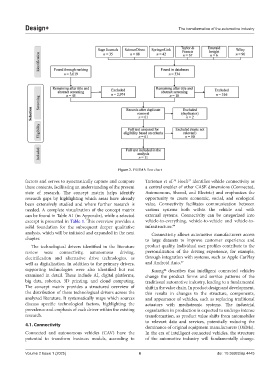
                                                   Figure 2. PRISMA flow chart

            factors and serves to systematically capture and compare   Turienzo et al.  Hoeft  identifies vehicle connectivity as
                                                                                 37
                                                                           38
            these contents, facilitating an understanding of the present   a central enabler of other CASE dimensions (Connected,
            state of research. The concept matrix helps identify   Autonomous, Shared, and Electric) and emphasizes the
            research gaps by highlighting which areas have already   opportunity to create economic, social, and ecological
            been extensively studied and where further research is   value. Connectivity facilitates communication between
            needed. A  complete visualization of the concept matrix   various systems both within the vehicle and with
            can be found in Table A1 (in Appendix), while a selected   external systems. Connectivity can be categorized into
            excerpt is presented in Table 1. This overview provides a   vehicle-to-everything, vehicle-to-vehicle and vehicle-to-
            solid  foundation for  the  subsequent  deeper  qualitative   infrastructure. 44
            analysis, which will be initiated and expanded in the next   Connectivity allows automotive manufacturers access
            chapter.                                           to large datasets to improve customer experience and

              The technological  drivers  identified in the  literature   product quality. Individual user profiles contribute to the
            review  were  connectivity,  autonomous  driving,  personalization  of the  driving experience, for  example,
            electrification and alternative drive technologies, as   through integration with systems, such as Apple CarPlay
            well as digitalization. In addition to the primary drivers,   and Android Auto. 37
            supporting technologies  were also identified  but  not   Kuang  describes that intelligent connected vehicles
                                                                       44
            examined in detail. These include AI, digital platforms,   change the product forms and service patterns of the
            big data, robotics, 3D printing, and cloud computing.   traditional automotive industry, leading to a fundamental
            The concept matrix provides a structured overview of   shift in the value chain. In product design and development,
            the distribution of these technological drivers across the   this results in changes to the structure, components,
            analyzed literature. It systematically maps which sources   and appearance of vehicles, such as replacing traditional
            discuss specific technological factors, highlighting the   actuators with mechatronic systems. The industrial
            prevalence and emphasis of each driver within the existing   organization in production is expected to undergo intense
            research.                                          transformation, as product value shifts from automobiles
                                                               to relevant data and services, potentially reducing the
            4.1. Connectivity
                                                               dominance of original equipment manufacturers (OEMs).
            Connected and  autonomous  vehicles  (CAV)  have  the   In the era of intelligent connected vehicles, the structure
            potential to transform business models, according to   of the automotive industry will fundamentally change.


            Volume 2 Issue 1 (2025)                         6                                doi: 10.36922/dp.4445

