


Page 57 - DP-2-2
P. 57
Design+                                                               Da Vinci AI Tutor in art history learning


            3. Methodology                                     sessions,  the  appropriate  demeanor  and accuracy  were
                                                               attained before the 3D animation build. The overview of
            3.1. Avatar design and production phases           training steps and prompting can be found in Table 1.
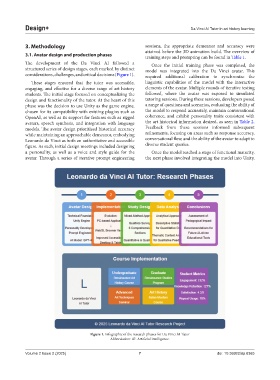
            The development of the Da Vinci AI followed a        Once the initial training phase was completed, the
            structured series of design stages, each marked by distinct   model was integrated into the Da Vinci avatar. This
            considerations, challenges, and critical decisions (Figure 1).   required  additional  calibration  to  synchronize  the
              These stages ensured that the tutor was accessible,   linguistic capabilities of the model with the interactive
            engaging, and effective for a diverse range of art history   elements of the avatar. Multiple rounds of iterative testing
            students. The initial stage focused on conceptualizing the   followed, where the avatar was exposed to simulated
            design and functionality of the tutor. At the heart of this   tutoring sessions. During these sessions, developers posed
            phase was the decision to use Unity as the game engine,   a range of questions and scenarios, evaluating the ability of
            chosen for its compatibility with existing plugins such as   the model to respond accurately, maintain conversational
            OpenAI, as well as its support for features such as rigged   coherence, and exhibit personality  traits  consistent  with
            avatars, speech synthesis, and integration with language   the art historical information desired, as seen in Table 2.
            models. The avatar design prioritized historical accuracy   Feedback from these sessions informed subsequent
            while maintaining an approachable demeanor, embodying   refinements, focusing on areas such as response accuracy,
            Leonardo da Vinci as both an authoritative and accessible   conversational flow, and the ability of the avatar to adapt to
            figure. As such, initial design meetings included designing   diverse student queries.
            a personality, as well as a voice and style guide for the   Once the model reached a stage of functional maturity,
            avatar. Through a series of iterative prompt engineering   the next phase involved integrating the model into Unity,


                                       Figure 1. Infographic of the research phases for Da Vinci AI Tutor
                                                Abbreviation: AI: Artificial intelligence.


            Volume 2 Issue 2 (2025)                         7                                doi: 10.36922/dp.8365

