


Page 99 - DP-2-2
P. 99
Design+                                                                 Modern interpretations of probability


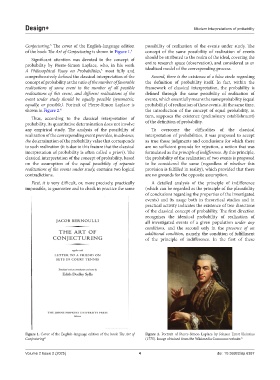
            Conjecturing.  The cover of the English-language edition   possibility of realization of the events under study. The
                      3
            of the book The Art of Conjecturing is shown in Figure 1. 4  concept  of  the same possibility  of  realization  of  events
              Significant attention was devoted to the concept of   should be attributed to the realm of the ideal, covering the
            probability by Pierre-Simon Laplace, who, in his work   entire research space (observation), and considered as an
            A Philosophical Essay on Probabilities,  most fully and   idealized model of the corresponding process.
                                            5
            comprehensively defined the classical interpretation of the   Second, there is the existence of a false circle regarding
            concept of probability as the ratio of the number of favorable   the definition of probability itself. In fact, within the
            realizations of some event to the number of all possible   framework of classical interpretation, the probability is
            realizations of this event, and different realizations of the   defined through the same possibility of realization of
            event under study should be equally possible (symmetric,   events, which essentially means the same probability (equal
            equally, or possible). Portrait of Pierre-Simon Laplace is   probability) of realization of these events. At the same time,
            shown in Figure 2. 6                               the introduction of the concept of equal probability, in

              Thus, according to the classical interpretation of   turn, supposes the existence (preliminary establishment)
            probability, its quantitative determination does not involve   of the definition of probability.
            any empirical study. The analysis of the possibility of   To overcome the difficulties of the classical
            realization of the corresponding event provides, in advance,   interpretation of probabilities, it was proposed to accept
            the determination of the probability value that corresponds   as true those judgments and conclusions for which there
            to such realization (it is due to this feature that the classical   are no sufficient grounds for rejection, a notion that was
            interpretation of probability is often called a priori). The   formulated as the principle of indifference. By this principle,
            classical interpretation of the concept of probability, based   the probability of the realization of two events is proposed
            on the assumption of the  equal possibility of separate   to  be  considered  the  same  (regardless  of whether  this
            realizations of the events under study, contains two logical   provision is fulfilled in reality), which provided that there
            contradictions.                                    are no grounds for the opposite assumption.
              First, it is very difficult, or, more precisely, practically   A detailed analysis of the principle of indifference
            impossible, to guarantee and to check in practice the same   (which can be regarded as the principle of the plausibility
                                                               of conclusions regarding the properties of the investigated
                                                               events) and its usage both in theoretical studies and in
                                                               practical activity indicates the existence of two directions
                                                               of the classical concept of probability. The first direction
                                                               recognizes the identical probability of realization of
                                                               all investigated events of a given population  under any
                                                               conditions,  and the second only in the  presence of an
                                                               additional condition, namely, the condition of fulfillment
                                                               of the principle of indifference. In the first of these


            Figure 1. Cover of the English-language edition of the book The Art of   Figure  2. Portrait of  Pierre-Simon  Laplace  by Johann Ernst  Heinsius
            Conjecturing 4                                     (1775). Image obtained from the Wikimedia Commons website. 6


            Volume 2 Issue 2 (2025)                         4                                doi: 10.36922/dp.6387

