


Page 94 - DP-2-2
P. 94
Design+                                                      Closed-form solution for pressurized obround shells


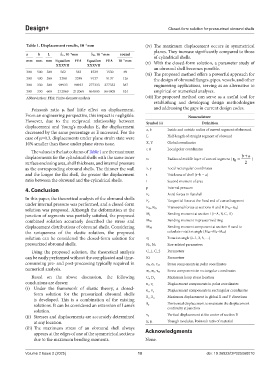
            Table 1. Displacement results, 10 mm               (iv)  The maximum displacement occurs in symmetrical
                                     −3
                                                                  planes. They increase significantly compared to those
            a    b   L     δC, 10 mm    δD, 10  mm  round         of cylindrical shells.
                               −4
                                            −4
            mm mm mm Equation    FEA  Equation   FEA  10  mm   (v)  With the closed-form solution, a parameter study of
                                                     −3
                         XXXVII       XXXVII
                                                                  an obround shell becomes possible.
            300  500  380  562   563    1529  1530    69       (vi) The proposed method offers a powerful approach for
            300  400  380  3388  3389   9137  9137   126          the design of obround flanges, pipes, vessels, and other
            300  330  380  98933  98933  277333  277333  387      engineering applications, serving as an alternative to
            300  330  600  212069  212069  864805  864805  524    empirical or numerical analyses.
            Abbreviation: FEA: Finite element analysis         (vii) The proposed method can serve as a useful tool for
                                                                  establishing and developing design methodologies
              Poisson’s ratio  μ had little effect on displacement.   and addressing the gaps in current design codes.
            From an engineering perspective, this impact is negligible.          Nomenclature
            However, due to the reciprocal relationship between   Symbol (s)           Definition
            displacement and Young’s modulus E, the displacement   a, b  Inside and outside radius of curved segment of obround
            decreased by the same percentage as E increased. For the
            case of μ=0.3, displacements under plane strain state were   L  Half-length of straight segment of obround
            10% smaller than those under plane stress issue.   X, Y     Global coordinates

              The values in the last column of Table 1 are the maximum   r, θ  Local polar coordinates
                                                                                                         +
            displacements for the cylindrical shells with the same inner   r0  Radius of middle layer of curved segment ( r =  ba  )
                                                                                                     0
            surface enclosing area, shell thickness, and internal pressure                               2
            as the corresponding obround shells. The thinner the wall   x, y  Local rectangular coordinates
            and the longer the flat shell, the greater the displacement    t  Thickness of shell (t=b − a)
            ratio between the obround and the cylindrical shells.  I    Second moment of area

            4. Conclusion                                      p        Internal pressure
                                                               Fx       Axial forces in flat shell
            In this paper, the theoretical analysis of the obround shells   Tangential force at the fixed end of curved segment
            under internal pressure was performed, and a closed-form   Fy
            solution was proposed. Although the deformation at the   FAy, FBy  Transversal forces at sections A and B (FAy=FBy)
            junction of segments was partially satisfied, the proposed   M i  Bending moment at section i (i=A, B, C, D)
            combined solution accurately described the stress and   MB1  Bending moment in pressurized ring
            displacement distributions of obround shells. Considering   MB2  Bending moment component at section B used to
            the uniqueness of the elastic solution, the proposed        calculate rotation angle (MB2=MB−MB1)
            solution can be considered the closed-form solution for   α i  Rotation angle (i=1, 2, 3, …)
            pressurized obround shells.                        N1, N2   Size-related parameters
              Using the proposed solution, the theoretical analysis   C_1, C_2   Parameters
            can be easily performed without the complicated and time-  Ki  Parameters
            consuming pre- and post-processing typically required in   σθ, σr, τrθ  Stress components in polar coordinates
            numerical analysis.                                σx, σy, τxy   Stress components in rectangular coordinates
              Based on the above discussion, the following     C i , D o  Maximum hoop stress location
            conclusions are drawn:                             u r , v t  Displacement components in polar coordinates
            (i)  Under the framework of elastic theory, a closed-       Displacement components in rectangular coordinates
               form solution for the pressurized obround shells   u x , v y  Maximum displacement in global X and Y directions
               is developed. This is a combination of the existing   δ C , δ D
               solutions. It can be considered an extension of Lame’s   δ 0  Horizontal displacement to maintain the displacement
                                                                        continuity at junction
               solution.
            (ii)  Stresses and displacements are accurately determined   v 0  Vertical displacement at the center of section B
               at any location.                                E, μ     Young’s modulus, Poisson’s ratio of material
            (iii) The maximum stress of an obround shell always   Acknowledgments
               appears at the edges of one of the symmetrical sections
               due to the maximum bending moments.             None.


            Volume 2 Issue 2 (2025)                         10                           doi: 10.36922/DP025060010

