


Page 93 - DP-2-2
P. 93
Design+                                                      Closed-form solution for pressurized obround shells


            center of this section was required in the analysis. The
            difference between the two was small, and their average
            provides a good approximation.
              The hoop stress distribution of Section B was similar
            to that of Section D, that is, the tension stress occurred at
            the outer surface. This suggests that the section where the
            hoop tensile stress shifted from the inner surface to the
            outer surface is located between section C and section B.

              In section B, the radial stress obtained using either
            Equation XXIII or XXVI was inaccurate. Lame’s solution
            provided a better result, even though this section is not a
            symmetry plane (Figure 8).
              The first and last terms in Equations XXII and XXIII
            are independent functions of  θ. They are axisymmetric
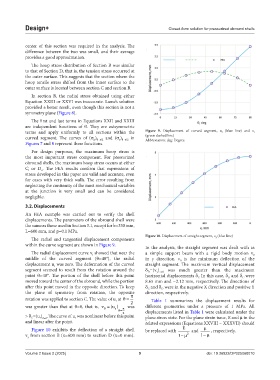
            terms and apply uniformly to all sections within the   Figure  9. Displacement of curved segment, u r  (blue line) and v t
            curved  segment.  The  curves  of  (σ )    and  (σ )    in   (green dashed line)
                                                               Abbreviation: deg: Degree.
                                                    r θ=π/2
                                         θ θ=π/2
            Figures 7 and 8 represent these functions.
              For design purposes, the maximum hoop stress is
            the  most important  stress  component.  For pressurized
            obround shells, the maximum hoop stress occurs at either
            C  or D . The FEA results confirm that expressions of
                   o
             i
            stress developed in this paper are valid and accurate, even
            for cases with very thick walls. The error resulting from
            neglecting the continuity of the most mechanical variables
            at the junction is very small and can be considered
            negligible.
            3.2. Displacements
            An FEA example was carried out to verify the shell
            displacements. The parameters of the obround shell were
            the same as those used in Section 3.1, except for b=330 mm,
            L=600 mm, and p=0.1 MPa.
                                                               Figure 10. Displacement of straight segment, v y  (blue line)
              The  radial  and  tangential  displacement  components
            within the curve segment are shown in Figure 9.    In the analysis, the straight segment was dealt with as
              The radial displacement curve v  showed that near the   a simple support beam with a rigid body motion v
                                        t
                                                                                                             0
            middle of the curved segment (θ≈48°), the radial   in  y direction.  v   is  the minimum  deflection  of  the
                                                                              0
            displacement u  was zero. The deformation of the curved   straight segment. The maximum vertical displacement
                        r
            segment seemed to result from the rotation around the   δ =(v )  was much greater than the maximum
                                                                    y x=0
                                                                D
            point  θ≈48°.  The  portion  of  the  shell  before  this  point   horizontal displacements δ  In this case, δ  and δ  were
                                                                                     C
                                                                                                  D
                                                                                                        C
            moved toward the center of the obround, while the portion   8.65 mm and −2.12 mm, respectively. The directions of
            after this point moved in the opposite direction. To keep   δ  and δ  were in the negative X direction and positive Y
                                                                      D
                                                                C
            the plane of symmetry from rotation, the opposite   direction, respectively.

            rotation was applied to section C. The value of u  at   =  2     Table 1 summarizes the displacement results for
                                                  r
                                                 u
            was  greater  than  that  at  θ=0,  that  is,  v = ()    was   different  geometries  under  a pressure of  1  MPa.  All
                                             0
                                                  r
                                                    =  2     displacements listed in Table 1 were calculated under the
            > δ =(u ) . The curve of u  was nonlinear before this point   plane stress state. For the plane strain issue, E and μ in the
              C
                                 r
                  r θ=0
            and linear after the point.                        related expressions (Equations XXVIII – XXXVII) should
              Figure  10 exhibits the deflection of a straight shell   be replaced with   E   and   µ  , respectively.
            v  from section B (x=600 mm) to section D (x=0 mm).              1− µ 2   1− µ
             y
            Volume 2 Issue 2 (2025)                         9                            doi: 10.36922/DP025060010

