


Page 88 - DP-2-2
P. 88
Design+ Closed-form solution for pressurized obround shells
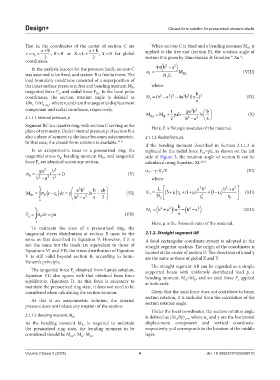
That is, the coordinates of the center of section C are When section C is fixed and a bending moment M is
B2
L
r = r 0 = a + b , θ = or X =+ ab+ , Y = 0 for global applied to the free end (section B), the rotation angle of
0
2
10
11
coordinates. 2 section B is given by Timoshenko & Goodier, Xu :
2
a
In the analysis (except for the pressure load), section C 4 ( b 2 − )
1
was assumed to be fixed, and section B is free to move. The = NE M B 2 (VIII)
1
load boundary conditions consisted of a superposition of
the inner surface pressure p, free end bending moment M , where:
B
tangential force F , and radial force F . In the local polar b
By
x
2 2
2
2 2
coordinates, the section rotation angle is defined as N = ( b − a ) − 4 a b (ln) 2 (IX)
1
(∂v t / ∂r ) r , where v and r are the tangential displacement a
t
=r 0
component and radial coordinate, respectively. 1 pa b b
22
M = M + pab − ln (X)
2
2.1.1.1. Internal pressure, p B2 B 2 b − a 2 a
Segment BC is a quarter ring, with section C serving as the Here, E is Young’s modulus of the material.
plane of symmetry. Under internal pressure p, if section B is
also a plane of symmetry, the issue becomes axisymmetric. 2.1.1.3. Radial force, pL
In that case, the closed-form solution is available. 10,11
If the bending moment described in Section 2.1.1.2 is
In an axisymmetric issue or a pressurized ring, the replaced by the radial force F =pL, as shown on the left
By
tangential stress σ , bending moment M , and tangential side of Figure 3, the rotation angle of section B can be
B1
θ
force F are identical across any section. calculated using Equation XI: 10,11
x
pa 2 b 2 α =−p K /E (XI)
= ( +1) (V) 2 1
b 2 − a 2 r 2 where:
22
2
b ab b ab L ab b + a 2
22
− (
=
M B1 ∫ r rdr ) = p 2 2 ln − (VI) K = N ( 5 + µ r ) ++ µ 0 1 ( ) r 3 + 1− ( ) µ r (XII)
1
0
a b − a a 2 2 0 0
2
2
2
2
b N =( b + ) ln b −( b − ) (XIII)
a
a
∫
F = dr = pa (VII) 2 a
x
a Here, μ is the Poisson’s ratio of the material.
To maintain the state of a pressurized ring, the
tangential stress distribution at section B must be the 2.1.2. Straight segment AB
same as that described in Equation V. However, if it is A local rectangular coordinate system is adopted in the
not the same but the loads are equivalent to those of straight segment analysis. The origin of the coordinates is
Equations VI and VII, the stress distribution of Equation located at the center of section D. The directions of x and y
V is still valid beyond section B, according to Saint- are the same as those of global X and Y.
Venant’s principle.
The straight segment AB can be regarded as a simple
The tangential force F obtained from Lame’s solution, supported beam with uniformly distributed load p, a
x
Equation VII also agrees with that obtained from force bending moment, M =M , and an axial force F applied
equilibrium (Equation I). As this force is necessary to at both ends. A B x
maintain the pressurized ring state, it does not need to be
considered when calculating the section rotation. Given that the axial force does not contribute to beam
section rotation, it is excluded from the calculation of the
As this is an axisymmetric solution, the internal
pressure does not induce any rotation of the section. section rotation angle.
Under the local coordinates, the section rotation angle
2.1.1.2. Bending moment, M B2 is defined as (∂u ⁄∂y) , where u and y are the horizontal
y=0
x
x
As the bending moment M is required to maintain displacement component and vertical coordinate,
B1
the pressurized ring state, the bending moment to be respectively. y=0 corresponds to the location of the middle
considered should be M = M −M . layer.
B
B1
B2
Volume 2 Issue 2 (2025) 4 doi: 10.36922/DP025060010

