


Page 86 - DP-2-2
P. 86
Design+                                                      Closed-form solution for pressurized obround shells


            simplified to an equivalent circular one. This allows the   As an obround shape consists of straight and circular
            use of a circular member design process for non-circular   sections, finding a stress function that satisfies both
            members.                                           straight and circular boundaries is extremely difficult, if not
              The American Society of Mechanical Engineers (s) code   impossible. Therefore, it is more practical to use separate
            adopted this concept by proposing a design-by-role method.   stress functions to satisfy different boundary conditions.
            In this approach, stresses at three potentially high-stress   In this study, the obround shape is divided into curved
            locations are estimated using empirical formulas and pre-  and straight segments, each with relatively simple geometry
            estimated shell thicknesses. The maximum stress obtained   and load boundary conditions.
            needs to be compared with the allowable stress to confirm   For a straight or circular segment with simple
            whether the pre-estimated thickness is acceptable. If the   boundary  loads,  theoretical  solutions  are  available.
            estimated thickness is found to be inappropriate, adjustments   By  using the superposition principle, introducing
            must be done. The maximum stresses are then recalculated   reasonable assumptions, and combining existing closed-
            and compared until an acceptable thickness is obtained. 1,2
                                                               form solutions of elastic theory, a closed-form solution
              Even if the shell thickness is deemed acceptable, the   for obround components under internal pressure is
            true stress within the shell remains unknown due to the   developed. This solution can be used to calculate stresses
            inaccuracy of empirical formulas. As a result, the thickness   and displacements at locations of interest.
            obtained through this process is not necessarily the
            minimum required. While this approach is generally safe,   Considering the uniqueness of the elastic solution,
            it may become overly conservative as the length-to-width   this formulation represents the closed-form theoretical
            ratio of the obround increases. 3                  solution for pressurized obround shells.
              At present, there is no empirical formula in design   Because the  stresses calculated using the proposed
            codes for estimating the displacement of obround shells.   method are accurate, it is possible to determine the
                                                                                       12
            The deformation of obround components is typically   minimum required thickness.  In addition, this method
            determined using numerical analysis methods.       can be applied to out-of-roundness analysis. 13
              Zheng  carried out a theoretical analysis of non-circular   2. Theoretic analysis
                    4
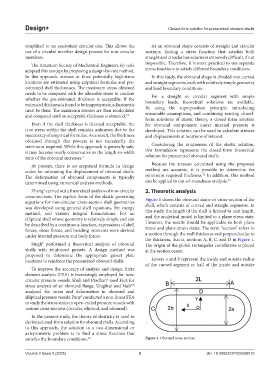
            cross-sections. The explicit form of the elastic governing   Figure 1 shows the obround shape or cross-section of the
            equations for non-circular cross-section shell geometries   shell, which consists of curved and straight segments. In
            was developed using general shell equations, the energy
            method, and various integral formulations. For an   this study, the length of the shell is limited to unit length,
            elliptical shell whose geometry is relatively simple and can   and the analytical model is limited to a plane stress state.
            be described by a continuous function, expressions of shell   However,  the  results  should  be  applicable  to  both plane
            forces, shear forces, and bending moments were derived   stress and plane strain states. The term “section” refers to
            under internal pressure and body forces.           a section through the wall thickness and perpendicular to
                                                               the thickness, that is, sections A, B, C, and D in Figure 1.
              Singh  performed a theoretical analysis of obround   The origin of the global rectangular coordinates is placed
                   5
            shells  with  reinforced  gussets.  A  design  method  was   at the section center.
            proposed to  determine  the  appropriate  gusset plate
            locations to reinforce the pressurized obround shells.   Letters a and b represent the inside and outside radius
                                                               of the curved segment or half of the inside and outside
              To improve the accuracy of analysis and design, finite
            element analysis (FEA) is increasingly employed for non-
            circular pressure vessels. Shah and Pradhan  used FEA for
                                              6
            stress analysis of an obround flange. Utagikar and Naik
                                                         7,8
            analyzed the stress and deformation in obround and
            elliptical pressure vessels. Pany  conducted a non-linear FEA
                                   9
            to study the stress states in open-ended pressure vessels with
            various cross-sections (circular, elliptical, and obround).
              In the present study, the theory of elasticity is used to
            derive a closed-form solution for obround shells. According
            to this approach, the solution to a two-dimensional or
            axisymmetric problem is to find a stress function that
            satisfies the boundary conditions. 10              Figure 1. Obround cross-section


            Volume 2 Issue 2 (2025)                         2                            doi: 10.36922/DP025060010

