


Page 87 - DP-2-2
P. 87
Design+                                                      Closed-form solution for pressurized obround shells


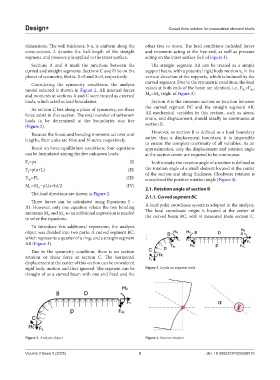
            dimensions. The wall thickness, b-a, is uniform along the   other  free  to  move.  The  load  conditions  included forces
            cross-section.  L  denotes the half-length of the straight   and moments acting at the free end, as well as pressure
            segment, and pressure p is applied to the inner surface.  acting on the inner surface (left of Figure 3).
              Sections  A and  B  mark the  junctions  between  the   The straight segment AB can be treated as a simple
            curved and straight segments. Sections C and D lie on the   support beam, with a potential rigid body motion v  in the
                                                                                                        0
            planes of symmetry, that is, Y=0 and X=0, respectively.  vertical direction at the supports, which is induced by the
              Considering the symmetry conditions, the analysis   curved segment. Due to the symmetric condition, the load
            model selected is shown in  Figure  2. All  internal forces   values at both ends of the beam are identical, i.e., F =F ,
                                                                                                        By
                                                                                                            Ay
            and moments at sections A and C were treated as external   M =M  (right of Figure 3).
                                                                    A
                                                                 B
            loads, which acted as load boundaries.               Section B is the common section or junction between
              As section C lies along a plane of symmetry, no shear   the curved segment BC and the straight segment AB.
            force exists in this section. The total number of unknown   All mechanical variables in this section, such as stress,
            loads to be determined at the boundaries was five   strain, and displacement, should ideally be continuous at
            (Figure 2).                                        section B.
              Because the forces and bending moments act over unit   However, as section B is defined as a load boundary
            lengths, their units are N/m and N-m/m, respectively.  rather than a displacement boundary, it is impossible
                                                               to ensure the complete continuity of all variables. As an
              Based on force equilibrium conditions, four equations   approximation, only the displacement and rotation angle
            can be formulated among the five unknown loads.    at the section center are required to be continuous.
            F =pa                                       (I)      In this study, the rotation angle of a section is defined as
             x
            F =p(a+L)                                  (II)    the rotation angle of a small element located at the center
             y
            F =PL                                      (III)   of the section and along thickness. Clockwise rotation is
                                                               considered the positive rotation angle (Figure 4).
             Ay
            M =M −pL(a+b)/2                            (IV)    2.1. Rotation angle of section B
              C
                 A
              The load directions are shown in Figure 2.
                                                               2.1.1. Curved segment BC
              Three forces can be calculated using Equations I –
            III. However, only one equation relates the two bending   A local polar coordinate system is adopted in the analysis.
            moments M  and M  so an additional expression is needed   The local coordinate origin is located at the center of
                     A
                            C
            to solve the equations.                            the  curved beam BC, with  θ measured from section C.
              To introduce this additional expression, the analysis
            object was divided into two parts: A curved segment BC,
            which represents a quarter of a ring, and a straight segment
            AB (Figure 3).
              Due to the symmetry condition, there is no section
            rotation or shear force at section C. The horizontal
            displacement at the center of this section can be considered
            rigid body motion and thus ignored. The segment can be   Figure 3. Loads on segment ends
            thought of as a curved beam with one end fixed and the


            Figure 2. Analysis object                          Figure 4. Section rotation


            Volume 2 Issue 2 (2025)                         3                            doi: 10.36922/DP025060010

