


Page 89 - DP-2-2
P. 89
Design+ Closed-form solution for pressurized obround shells
If M is considered positive, then M should be negative.
2.1.2.1. Bending moment, M B D C
For a pure bending beam, the rotation angle at the section The hoop tensile stress occurs on the outer surface of
center of the beam’s end (at x=L) is given by Timoshenko the positive bending moment section and on the inner
10
& Goodier : surface of the negative bending moment section. Due to
the continuity of the geometry and load boundaries of the
ML analysis model, it is expected that from section C to section
B
α =− EI (XIV) D, the bending moment will smoothly transition from
3
M to M . M and M should be the maximum negative
D
C
D
C
This result matched the end slope of the beam axis in and positive bending moments in the shell, respectively.
beam theory, as the assumption that the beam sections Consequently, the maximum hoop stresses should occur
14
remain planar held true. on the inner surface of section C or the outer surface of
section D. C and D are used to represent those two
2.1.2.2. Uniform distributed load, p i o
positions (Figure 1).
The rotation angle at section B under uniformly distributed
load can be calculated by Equation XV 10,11 : 2.3. Stress
α =p K /E (XV) In axisymmetric or plane stress issues, there are two normal
4
2
where: stresses (tangential or axial and radial or transversal) and
one shear stress. Due to the linear system (geometry and
L 3 L 1 µ 2 material), the superimposition principle is valid to obtain
K =− I 3 + I 4 5 + 2 ( ba) (XVI) full stress.
−
2
2.3.1. Curved segment BC
Here, I is the second moment of the area.
Under the local polar coordinate system, stress components
The first term in Equation XVI is the result of the beam are described as follows: 10
theory, while the second term represents the shear effect
14
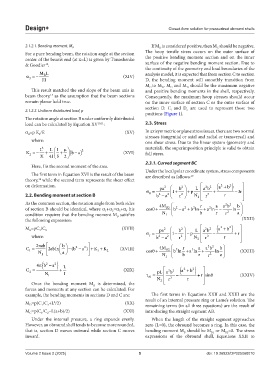
on deformation. pa 2 b 2 L 22 ( a 2 + )
2
b
ab
= 1 + + p + − r 3
2.2. Bending moment at section B b 2 − a 2 r 2 N 2 r 3 r
As the common section, the rotation angle from both sides 4M r a ab b
22
2
2
of section B should be identical, where α +α =α +α his cos ++ B 2 b 2 − a 2 + bln + aln − ln
1
4
2
3
condition requires that the bending moment M satisfies N 1 b r r 2 a
B
the following expression: (XXII)
ab (
2
2
b
M =pC /C 2 (XVII) pa 2 b L 22 a + )
2
B
1
r
where: = b − a 1 − r − p N r 3 − r + r
2
2
2
2
2π ab b 22
r
a
2
2
C = N 1 2 abln −( b − a ) + K + K 2 (XVIII) cos + 4 4M 1 bln + aln + ab ln b (XXIII)
2
2
2
B
1
1
a
b
r
N
2
a
r
2
2
4 ( π b − ) L
a
C = N 1 + I (XIX) = pL ab ( a + ) + rsin (XXIV)
2
2
b
22
2
−
2
Once the bending moment M is determined, the r N r 3 r
B
forces and moments at any section can be calculated. For
example, the bending moments in sections D and C are: The first terms in Equations XXII and XXIII are the
result of an internal pressure ring or Lame’s solution. The
M =p(C /C +L /2) (XX) remaining terms (in all three equations) are the result of
2
2
1
D
M =p(C /C −L(a+b)/2) (XXI) introducing the straight segment AB.
1
2
C
Under the internal pressure, a ring expands evenly. When the length of the straight segment approaches
However, an obround shell tends to become more rounded, zero (L=0), the obround becomes a ring. In this case, the
that is, section D moves outward while section C moves bending moment M should be M or M =0. The stress
B
B1
B2
inward. expressions of the obround shell, Equations XXII to
Volume 2 Issue 2 (2025) 5 doi: 10.36922/DP025060010

