


Page 126 - DP-2-3
P. 126
Design+                                                             ML for predicting Alzheimer’s progression


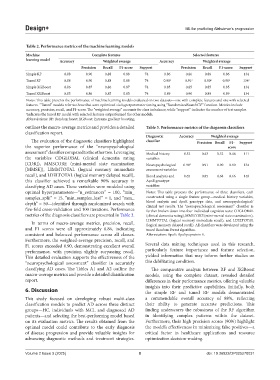
            Table 2. Performance metrics of the machine learning models
            Machine                     Complete features                          Selected features
            learning model  Accuracy         Weighted average        Accuracy          Weighted average
                                    Precision  Recall  F1‑score  Support      Precision  Recall  F1‑score  Support
            Simple RF       0.88      0.90    0.88    0.88     74      0.86     0.86    0.86    0.86     134
            Tuned RF        0.88      0.90    0.88    0.88     74      0.90 a   0.91 a  0.90 a  0.90 a  134 a
            Simple XGBoost  0.86      0.87    0.86    0.87     74      0.85     0.85    0.85    0.85     134
            Tuned XGBoost   0.85      0.86    0.85    0.85     74      0.89     0.90    0.89    0.89     134
            Notes: This table presents the performance of machine learning models evaluated on two datasets—one with complete features and one with selected
            features. “Tuned” models refer to those that were optimized via hyperparameter tuning using “RandomizedSearchCV” function. Metrics include
            accuracy, precision, recall, and F1-score. The “weighted average” accounts for class imbalance, while “support” indicates the number of test samples.
            a Indicates the tuned RF model with selected features outperformed the other models.
            Abbreviations: RF: Random forest; XGBoost: Extreme gradient boosting.
            outlines the macro-average metrics and provides a detailed   Table 3. Performance metrics of the diagnosis classifiers
            classification report.
                                                               Diagnostic    Accuracy      Weighted average
              The evaluation of the diagnostic classifiers highlighted   classifier  Precision Recall  F1‑   Support
            the superior performance of the “neuropsychological                                   score
            assessment” classifier compared to the other two. Leveraging   Medical history   0.52  0.43  0.52  0.46  111
            the variables CDGLOBAL (clinical dementia rating   variables
            [CDR]), MMSCORE (mini-mental state examination     Neuropsychological   0.90 a  0.91  0.90  0.90  134
            [MMSE]), LIMMTOTAL (logical memory immediate       assessment variables
            recall), and LDELTOTAL (logical memory delayed recall),   Blood analysis and   0.65  0.85  0.68  0.66  148
            this classifier achieved a remarkable 90% accuracy in   ApoE genotype
            classifying AD cases. These variables were modeled using   variables
            optimal hyperparameters—“n_estimators”  = 100, “min_  Notes: This table presents the performance of three classifiers, each
            samples_split” = 15, “min_samples_leaf” = 1, and “max_  constructed using a single feature group—medical history variables,
            depth” = 50—identified through randomized search with   blood analysis and ApoE genotype data, and neuropsychological/
                                                               clinical test results. The “neuropsychological assessment” classifier is
            five-fold cross-validation and 100 iterations. Performance   further broken down into four individual cognitive tests: CDGLOBAL
            metrics of the diagnosis classifiers are presented in Table 3.  (clinical dementia rating), MMSCORE (mini-mental state examination),
                                                               LIMMTOTAL (logical memory immediate recall), and LDELTOTAL
              In terms of macro-average metrics, precision, recall,   (logical memory delayed recall). All classifiers were developed using the
            and F1 scores were all approximately 0.86, indicating   tuned Random Forest algorithm.
            consistent  and balanced performance  across all classes.   Abbreviation: ApoE: Apolipoprotein E.
            Furthermore, the weighted-average precision, recall, and
            F1 scores exceeded 0.90, demonstrating excellent overall   Several  data  mining  techniques  used  in  this  research,
            performance, with precision slightly surpassing recall.   particularly feature importance and feature selection,
            This detailed evaluation supports the effectiveness of the   yielded information that may inform further studies on
            “neuropsychological assessment” classifier in accurately   this debilitating condition.
            classifying  AD  cases.  The  Tables  A1  and  A2  outline  the   The comparative analysis between RF and XGBoost
            macro-average metrics and provide a detailed classification   models, using the complete dataset, revealed detailed
            report.                                            differences in their performance metrics, offering valuable
                                                               insights into their predictive capabilities. Initially, both
            6. Discussion                                      the simple  RF and tuned RF models demonstrated
            This  study focused on developing  robust multi-class   a commendable overall accuracy of 88%, reflecting
            classification models to predict AD across three distinct   their ability to generate accurate predictions. This
            groups—HC, individuals with MCI, and diagnosed AD   finding underscores the robustness of the RF algorithm
            patients—and selecting the best-performing model based   in identifying complex patterns within the dataset.
            on its evaluation metrics. The results obtained from the   Furthermore, their high precision scores (90%) highlight
            optimal model could contribute to the early diagnosis   the model’s effectiveness in minimizing false positives—a
            of disease progression and provide valuable insights for   critical factor  in healthcare applications and  resource
            advancing diagnostic methods and treatment strategies.   optimization decision-making.


            Volume 2 Issue 3 (2025)                         8                            doi: 10.36922/DP025270031

