


Page 86 - EER-1-1
P. 86
Explora: Environment
            and Resource                                        Experimental application of GQDs for nuclear materials removal


            2.3.3. Atomic force microscopy: topography and      A
            phase imaging
              Atomic  force  microscopy  was  performed using a
            Bruker Multimode 8 (Bruker Corporation, Germany
            Manufacturer,  Country)  with  Nanoscope  Analysis  1.50
            software in tapping mode. This facilitated the acquisition
            of topographic and phase images to ascertain particle   B
            diameter, height, and phase composition. The cantilever
            had a spring constant of 0.24 N/m and a nominal tip radius
            of 2 nm. The particle solutions, diluted to approximately 10
                                                          9
            to 10  particles/cm , were applied to freshly cleaved mica
                           3
                10
            and dried in a vacuum chamber. The scanning resolution
            was 256 × 256 lines at a frequency of 0.5 Hz.
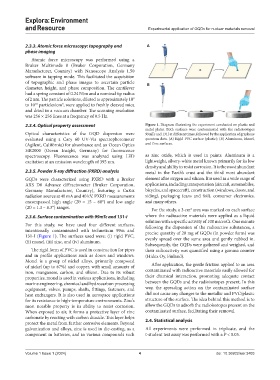
            2.3.4. Optical property assessment                 Figure 1. Diagram illustrating the experiment conducted on plastic and
                                                               metal plates. Both surfaces were contaminated with the radioisotopes
            Optical characteristics  of the  GQD dispersion  were   99mTc and 131I at different times, followed by the application of graphene
            evaluated using a Cary 60 UV-Vis spectrophotometer   quantum dots. (A) Rigid PVC surface (plastic); (B) Aluminum, Monel,
            (Agilent, Califórnia) for absorbance and an Ocean Optics   and Zinc surfaces.
            HR2000 (Ocean Insight, Germany) for fluorescence
            spectroscopy.  Fluorescence  was  analyzed  using  LED   as  zinc  oxide, which is used in paints. Aluminum is a
            excitation at an emission wavelength of 395 nm.    lightweight, silvery-white metal known primarily for its low
                                                               density and ability to resist corrosion. It is the most abundant
            2.3.5. Powder X-ray diffraction (PXRD) analysis    metal in the Earth’s crust and the third most abundant
            GQDs were characterized using PXRD  with a Bruker   element after oxygen and silicon. It is used in a wide range of
            AXS  D8  Advance  diffractometer  (Bruker  Corporation,   applications, including transportation (aircraft, automobiles,
            Germany  Manufacturer,  Country),  featuring  a  CuKα   bicycles, and spacecraft), construction (windows, doors, and
            radiation source at 40 mA and 40 kV. PXRD measurements   siding), packaging (cans and foil), consumer electronics,
            encompassed high angle (2θ = 15 – 68°) and low angle   and many others.
            (2θ = 1.3 – 8.3°) ranges.                            For the study, a 3 cm  area was marked on each surface
                                                                                  2
            2.3.6. Surface contamination with 99mTc and 131-I  where the radioactive materials were applied as a liquid
                                                               solution with a specific activity of 100 microCi. One minute
            For this study, we have used four different surfaces,   following the dispersion of the radioactive substances, a
            intentionally contaminated with technetium 99m and   precise quantity of 20 mg of GQDs (in powder form) was
            131-I (Figure  1). The surfaces used were: (i) rigid PVC,   evenly spread over the same area and gently rubbed in.
            (ii) monel, (iii) zinc, and (iv) aluminum.
                                                               Subsequently, the GQDs were gathered and weighed, and
              The rigid form of PVC is used in construction for pipes   their radioactivity was quantified using a gamma counter
            and in profile applications such as doors and windows.   (Hidex Oy, Finland).
            Monel is a group of nickel alloys, primarily composed
            of nickel (up to 67%) and copper, with small amounts of   After application, the gentle friction applied to an area
            iron, manganese, carbon, and silicon. Due to its robust   contaminated with radioactive materials easily allowed for
            properties, monel is used in various applications, including   their chemical interaction, promoting adequate contact
            marine engineering, chemical and hydrocarbon processing   between the GQDs and the radioisotopes present. In this
            equipment, valves, pumps, shafts, fittings, fasteners, and   way, the spreading  action on the contaminated surface
            heat exchangers. It is also used in aerospace applications   did not cause any changes to the metallic and PVC/plastic
            for its resistance to high-temperature environments. Zinc’s   structure of the surface. The idea behind this method is to
            most notable property is its ability to resist corrosion.   allow the GQDs to adsorb the radioisotopes present on the
            When exposed to air, it forms a protective layer of zinc   contaminated surface, facilitating their removal.
            carbonate by reacting with carbon dioxide. This layer helps   2.4. Statistical analysis
            protect the metal from further corrosive elements. Beyond
            galvanization and alloys, zinc is used in die-casting, as a   All experiments were performed in triplicate, and the
            component in batteries, and in various compounds such   t-student test assay was performed with a P < 0.05.


            Volume 1 Issue 1 (2024)                         4                                doi: 10.36922/eer.3403

