


Page 88 - EER-1-1
P. 88
Explora: Environment
            and Resource                                        Experimental application of GQDs for nuclear materials removal


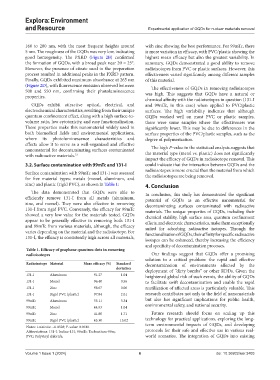
            160  to  280  nm, with the most frequent heights around   with zinc showing the best performance. For 99mTc, there
            5 nm. The roughness of the GQDs was very low, indicating   is more variation in efficacy, with PVC/plastic showing the
            good homogeneity. The PXRD (Figure  2B) confirmed   highest mean efficacy but also the greatest variability. In
            the formation of GQDs, with a broad peak near 2θ = 25°.   summary, GQDs demonstrated a good ability to remove
            However, the presence of citrate used in the preparation   radioisotopes from PVC or plastic surfaces. However, this
            process resulted in additional peaks in the PXRD pattern.   effectiveness varied significantly among different samples
            Finally, GQDs exhibited maximum absorbance at 265 nm   of this material.
            (Figure 2D), with fluorescence emission observed between   The effectiveness of GQDs in removing radioisotopes
            500 and 550  nm, confirming their photoluminescence   was high. This suggests that GQDs have a natural or
            properties.
                                                               chemical affinity with the radioisotopes in question (131-I
              GQDs  exhibit attractive optical, electrical, and   and 99mTc, in this case) when applied to PVC/plastic
            electrochemical characteristics, resulting from their unique   surfaces. The high variability indicates that although
            quantum confinement effect, along with a high surface-to-  GQDs worked well on most PVC or plastic samples,
            volume ratio, low cytotoxicity, and easy functionalization.   there  were  some  samples  where  the  effectiveness  was
            These properties make this nanomaterial widely used in   significantly lower. This may be due to differences in the
            both  biomedical  fields  and  environmental  applications,   surface properties of the PVC/plastic samples, such as the
            where  its photoluminescence  characteristics and   degree of polymerization.
            effects allow it to serve as a well-organized and effective
            nanomaterial for decontaminating surfaces contaminated   The high P-value in the statistical analysis suggests that
            with radioactive materials. 31                     the material type (metal vs. plastic) does not significantly
                                                               impact the efficacy of GQDs in radioisotope removal. This
            3.2. Surface contamination with 99mTc and 131-I    could indicate that the interaction between GQDs and the
                                                               radioisotopes is more crucial than the material from which
            Surface contamination with 99mTc and 131-I was assessed   the radioisotopes are being removed.
            for five material types: metals (monel, aluminum, and
            zinc) and plastic (rigid PVC), as shown in Table 1:  4. Conclusion
              The  data  demonstrated  that  GQDs  were  able  to   In conclusion, this study has demonstrated the significant
            efficiently remove 131-I from all metals (aluminum,   potential of GQDs as an effective nanomaterial for
            zinc, and monel). They were also effective in removing   decontaminating surfaces contaminated with radioactive
            131-I from rigid PVC. Conversely, the efficacy for 99mTc   materials.  The  unique  properties  of  GQDs,  including  their
            showed a very low value for the materials tested. GQDs   chemical stability, high surface area, quantum confinement
            appear to be generally effective in removing both 131-I   effects, and electronic characteristics, make them exceptionally
            and 99mTc from various materials, although, the efficacy   suited for adsorbing radioactive isotopes. Through the
            varies depending on the material and the radioisotope. For   functionalization of GQDs, their affinity for specific radioactive
            131-I, the efficacy is consistently high across all materials,
                                                               isotopes can be enhanced, thereby increasing the efficiency
                                                               and specificity of decontamination processes.
            Table 1. Efficacy of graphene quantum dots in removing
            radioisotopes                                        Our findings suggest that GQDs offer a promising
                                                               solution to a critical problem: the rapid and effective
            Radioisotope Material    Mean efficacy (%)  Standard   decontamination  of  environments  affected  by  the
                                                  deviation    deployment of “dirty bombs” or other RDDs. Given the
            131-I     Aluminum           91.27      1.04       heightened global risk of such events, the ability of GQDs
            131-I     Monel              96.40      0.56       to facilitate swift decontamination and enable the rapid
            131-I     Zinc               98.67      0.06       reutilization of affected areas is particularly valuable. This
            131-I     Rigid PVC (plastic)  97.84    2.01       research contributes not only to the field of nanomaterials
            99mTc     Aluminum           55.11      5.34       but  also  has  significant  implications  for  public  health,
            99mTc     Monel              64.93      1.04       environmental safety, and national security.
            99mTc     Zinc               41.80      1.71         Future  research  should  focus  on  scaling  up  this
            99mTc     Rigid PVC (plastic)  65.30    15.02      technology for practical applications, exploring the long-
            Notes: t-statistic: −0.0528; P-value: 0.9640.      term environmental impacts of GQDs, and developing
            Abbreviations: 131-I: Iodine-131; 99mTc: Technetium-99m;   protocols for their safe and effective use in various real-
            PVC: Polyvinyl chloride.                           world scenarios. The integration of GQDs into existing


            Volume 1 Issue 1 (2024)                         6                                doi: 10.36922/eer.3403

