


Page 87 - EER-1-1
P. 87
Explora: Environment
            and Resource                                        Experimental application of GQDs for nuclear materials removal


            3. Results and discussion                          with the planar configuration of sp2-bonded carbon.
                                                               The band’s position is independent of the laser excitation
            3.1. Development of GQDs and characterizations     frequency, distinguishing it from other graphene bands and
            GQDs can be produced using top-down and bottom-up   allowing the determination of  graphene layer thickness.
            strategies, involving methods, such as electron beam   As layer thickness increases, the band’s position shifts to
            lithography, hydrothermal routes, acidic exfoliation,   lower energy, reflecting a slight softening of the bonds. The
            and chemical oxidation. These methods vary in terms   D bands are related to collective vibration modes of rings
            of equipment requirements, cost, yield, and emission   in the graphene network adjacent to edges or defects, while
            color of GQDs. A green, environmentally friendly route   the 2D band refers to second-order processes. Changes
            using deionized water and glucose as pre-cursors has   in the shapes, positions, and intensities of these bands
            been described, capable of producing organic solvent-  reflect structural changes and electronic properties. The
            free GQDs suitable for biological applications. Using the   intensity ratio between the D and G bands (ID/IG) is used
            Stokes-Einstein  equation,  the  DLS  technique  estimated   to estimate structural disorder. 29,30
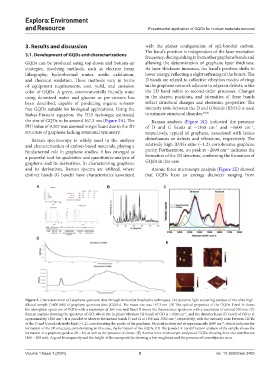
            the size of GQDs to be around 167.3 nm (Figure 2A). The   Raman analysis (Figure  2C) indicated the presence
            PDI value of 0.507 was deemed insignificant due to the 2D   of D and G bands at ~1360 cm  and ~1600 cm ,
                                                                                            −1
                                                                                                            −1
            structure of graphene lacking rotational symmetry.  respectively, typical of  graphene, associated with lattice
              Raman spectroscopy is widely used in the analysis   disturbances or defects and vibrations, respectively. The
            and characterization of carbon-based materials, playing a   relatively high ID/IG ratio (~1.2) corroborates graphene
                                                                                                 −1
            fundamental role in graphene studies. It has emerged as   purity. Furthermore, no peak at ~2690 cm  indicates the
            a powerful tool for qualitative and quantitative analysis of   formation of the 2D structure, confirming the formation of
            graphene and its derivatives. In characterizing  graphene   GQDs in this case.
            and its derivatives, Raman spectra are utilized, where   Atomic force microscopy analysis (Figure 2E) showed
            distinct bands (G bands) have characteristics associated   that GQDs have an average diameter ranging from

                 A                             B                       C


                 D
                                                                       E


            Figure 2. Characterization of Graphene quantum dots through molecular biophysics techniques. (A) dynamic light scattering analysis of the ultra-high-
            diluted sample (1:400.000) of graphene quantum dots (GQDs). The mean size was 167.3 nm. (B) The optical properties of the GQDs. Panel A shows
            the absorption spectrum of GQDs with a maximum of 265 nm, and Panel B shows the fluorescence spectrum with a maximum of around 530 nm. (C)
            Raman analysis showing the spectrum of GO, where the in-phase vibration (G band) of GO is ~1600 cm , and the disorder band (D band) of GO is at
                                                                               −1
            approximately 1360 cm . It is possible to observe the intense bands D and G at 1356 and 1582 cm , respectively, with the intensity ratio between ID/IG
                                                                           −1
                           −1
            of the D and G peak relatively high (~1.2), corroborating the purity of the graphene. No peak is observed at approximately 2690 cm , which indicates the
                                                                                               −1
            formation of the 2D structure, corroborating, in this case, the formation of the GQDs. (D) The powder X-ray diffraction analysis of the sample shows the
            formation of a graphene peak at 2θ = 10, as well as the presence of citrate. (E) Atomic force microscopic analysis of GQDs showing their size distribution
            (160 – 280 nm). A good homogeneity and the height of the nanoparticles showing a low roughness and the presence of coverslips are seen.
            Volume 1 Issue 1 (2024)                         5                                doi: 10.36922/eer.3403

