


Page 28 - EER-2-1
P. 28
Explora: Environment
            and Resource                                                  Evaluating agricultural efficiency and sustainability


            derived from these studies. Nevertheless, the imperative   recommendations and scientific guidance to enhance the
            challenge  of  integrating  international  experience  with   optimization of agricultural resource allocation and foster
            local requirements and developing agricultural efficiency   sustainable agricultural development in Shaanxi province.
            optimization  solutions  tailored  to  China’s  distinctive   The second section of this paper is a literature review
            agricultural structure, resource endowment, and    that examines pertinent studies on agricultural efficiency
            socioeconomic conditions remains unresolved.       assessment and SLM. The third section introduces model
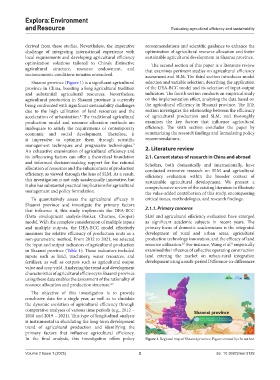
              Shaanxi province (Figure 1) is a significant agricultural   selection and variable selection, describing the application
            province in China, boasting a long agricultural tradition   of the DEA-BCC model and its selection of input-output
            and substantial agricultural resources. Nevertheless,   indicators. The fourth section conducts an empirical study
            agricultural production in Shaanxi province is currently   on the implementation effect, analyzing the data based on
            being confronted with significant sustainability challenges   the  agricultural  efficiency  in  Shaanxi  province.  The  fifth
            due to the high utilization of land resources and the   section investigates the relationship between the efficiency
                                   2
            acceleration of urbanization.  The traditional agricultural   of  agricultural  production  and  SLM, and  thoroughly
            production model and resource allocation methods are   examines the key factors that influence agricultural
            inadequate to satisfy  the requirements of  contemporary   efficiency. The sixth section concludes the paper by
            economic and social development. Therefore, it     summarizing the research findings and formulating policy
            is imperative to optimize them through scientific   recommendations.
            management techniques and progressive technologies.
                                                          3
            An exhaustive examination of agricultural efficiency and   2. Literature review
            its influencing factors can offer a theoretical foundation   2.1. Current status of research in China and abroad
            and informed decision-making support for the rational   Scholars, both domestically and internationally, have
            allocation of resources and the enhancement of production   conducted extensive research on SLM and agricultural
            efficiency, as viewed through the lens of SLM. As a result,   efficiency evaluation within the broader context of
            this investigation is not only academically innovative, but   sustainable agricultural development. We present a
            it also has substantial practical implications for agricultural   comprehensive review of the existing literature to illustrate
            management and policy formulation.                 the value-added contribution of this study, encompassing
              To quantitatively assess the agricultural efficacy in   critical issues, methodologies, and research findings.
            Shaanxi province and investigate the primary factors
            that influence it, this study implements the DEA-BCC   2.1.1. Primary concerns
            (Data envelopment analysis-Banker, Charnes, Cooper)   SLM and agricultural efficiency evaluation have emerged
            model. With the complete consideration of multiple inputs   as significant academic subjects in recent years. The
            and multiple outputs, the DEA-BCC model effectively   primary focus of domestic academicians is the integrated
            measures the relative efficiency of production units as a   development of rural and urban areas, agricultural
            non-parametric method. From 2012 to 2021, we selected   production technology innovation, and the efficacy of land
                                                                              6,7
            the input and output indicators of agricultural production   resource utilization.  For instance, Wang et al.  empirically
                                                                                                   8
            in Shaanxi province (Table 1). These indicators included   examined the influence of collective operating construction
            inputs such as land, machinery, water resources, and   land entering the market on urban-rural integration
            fertilizer, as  well  as outputs such as  agricultural output   development using a multi-period Difference-in-differences
            value and crop yield. Analyzing the trend and development
            characteristics of agricultural efficiency in Shaanxi province
            using these data enables the assessment of the rationality of
            resource allocation and production structure. 4,5
              The objective of this investigation is to provide
            conclusive data for a single year, as well as to elucidate
            the dynamic evolution of agricultural efficiency through
            comparative analyses of various time periods (e.g., 2012 –
            2018 and 2019 – 2021). This type of longitudinal analysis
            is instrumental in elucidating the long-term development
            trend of agricultural production and identifying the
            primary factors that influence agricultural efficiency.
            In the final analysis, this  investigation offers policy   Figure 1. Regional map of Shaanxi province. Figure created by the author.


            Volume 2 Issue 1 (2025)                         2                                doi: 10.36922/eer.5129

