


Page 29 - EER-2-1
P. 29
Explora: Environment
            and Resource                                                  Evaluating agricultural efficiency and sustainability


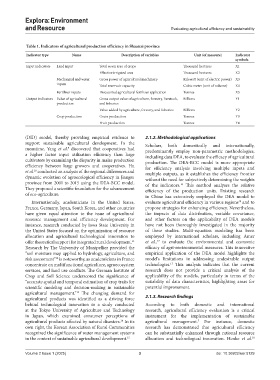
            Table 1. Indicators of agricultural production efficiency in Shaanxi province
            Indicator type      Name                 Description of variables       Unit (of measure)  Indicator
                                                                                                     symbols
            Input indicators  Land input   Total sown area of crops            Thousand hectares     X1
                                           Effective irrigated area            Thousand hectares     X2
                         Mechanical and water   Gross power of agricultural machinery  Kilowatt (unit of electric power)  X3
                         inputs            Total reservoir capacity            Cubic meter (unit of volume)  X4
                         Fertilizer inputs  Discounted agricultural fertilizer application  Tonnes   X5
            Output indicators Value of agricultural   Gross output value of agriculture, forestry, livestock,   Billions  Y1
                         production        and fisheries
                                           Value added by agriculture, forestry, and fisheries  Billions  Y2
                         Crop production   Grain production                    Tonnes                Y3
                                           Fruit production                    Tonnes                Y4


            (DID) model, thereby providing empirical evidence to   2.1.2. Methodological applications
            support sustainable agricultural development. In the   Scholars,  both  domestically  and  internationally,
                              9
            meantime, Yang  et al.  discovered that cooperatives had   predominantly employ non-parametric methodologies,
            a higher factor input utilization efficiency than large   including data DEA, to evaluate the efficacy of agricultural
            cultivators by examining the disparity in maize production   production. The DEA-BCC model is more appropriate
            efficiency  between  large growers  and  cooperatives.  Hu   for efficiency analysis involving multiple inputs and
            et al.  conducted an analysis of the regional differences and   multiple outputs, as it establishes the efficiency frontier
               10
            dynamic evolution of agroecological efficiency in Jiangsu   without the need for subjectively determining the weights
            province from 2001 to 2015 using the DEA-BCC model.   of the indicators.  This method analyses the relative
                                                                              16
            They proposed a scientific foundation for the advancement   efficiency of the production units. Existing research
            of eco-agriculture.                                in  China has extensively  employed  the  DEA  model  to
              Internationally,  academicians  in  the  United  States,   evaluate agricultural efficiency in various regions  and to
                                                                                                       10
            France, Germany, Japan, South Korea, and other countries   propose strategies for enhancing efficiency. Nevertheless,
            have given equal attention to the issue of agricultural   the impacts of data distribution, variable covariance,
            resource  management  and  efficiency  development.  For   and other factors on the applicability of DEA models
            instance, research conducted by Iowa State University in   have not been thoroughly investigated in the majority
            the United States focused on the optimization of resource   of these studies. Multi-equation modeling has been
            allocation and agricultural technological innovation to   employed by international scholars, including Amer
            offer theoretical support for integrated rural development.    et al.,  to evaluate the environmental and economic
                                                                    17
                                                         11
            Research by The University of Montpellier provided the   efficacy of agri-environmental measures. This innovative
            “soil moisture map applied to hydrology, agriculture, and   empirical  application  of  the  DEA  model  highlights  the
            risk assessment”  is noteworthy, as academicians in France   model’s limitations in addressing undesirable output
                         12
            concentrate on multifunctional agriculture, agroecosystem   technologies.  This analysis indicates that the current
                                                                         17
            services, and land use conflicts. The German Institute of   research does not provide a critical analysis of the
            Crop and Soil Science underscored the significance of   applicability of the models, particularly in terms of the
            “accurate spatial and temporal estimation of crop traits for   suitability of data characteristics, highlighting areas for
            scientific modeling and decision-making in sustainable   potential improvement.
            agricultural management.”  The changing demand for
                                  13
            agricultural products was identified as a driving force   2.1.3. Research findings
            behind technological innovation in a study conducted   According  to  both  domestic  and  international
            at the Tokyo University of Agriculture and Technology   research, agricultural efficiency evaluation is a critical
            in  Japan, which examined consumer  perceptions of   instrument for the implementation of sustainable
            agricultural products affected by natural disasters.  In its   agricultural management.  For instance, domestic
                                                    14
                                                                                     7
            own right, the Korean Association of Rural Communities   research has demonstrated that agricultural efficiency
            recognized the significance of water management systems   can be substantially enhanced through rational resource
            in the context of sustainable agricultural development. 15  allocation and technological innovation. Henke  et al.
                                                                                                            18
            Volume 2 Issue 1 (2025)                         3                                doi: 10.36922/eer.5129

