


Page 33 - EER-2-1
P. 33
Explora: Environment
            and Resource                                                  Evaluating agricultural efficiency and sustainability


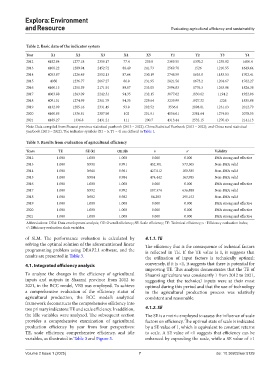
            Table 2. Basic data of the indicator system
            Year       X1        X2         X3        X4       X5         Y1        Y2         Y3        Y4
            2012     4182.84    1277.18    2350.17    77.4     239.8    2309.55    1370.2    1255.92    1600.4
            2013     4108.22    1209.94    2452.72   88.49    241.73    2569.78     1526     1210.55    1649.64
            2014     4053.87    1226.49    2552.13   87.64    230.19    2748.59    1635.8    1183.53    1702.41
            2015      4050      1236.77    2667.27    86.8    231.95    2821.56    1673.2    1204.67    1762.27
            2016     4160.15    1251.39    2171.91   89.87    233.05    2994.83    1776.3    1263.96    1826.38
            2017     4063.88    1263.09    2242.51   94.35    232.15    3077.62    1830.62    1194.2    1922.06
            2018     4091.01    1274.99    2311.79   94.35    229.64    3239.99    1927.32    1226      1835.08
            2019     4132.09    1285.16    2331.49    93.8    202.52     3536.8    2098.01   1231.13    2012.79
            2020     4160.85    1336.81    2387.96    102     201.91    4056.61    2381.64   1274.83    2070.55
            2021     4189.27    1336.8     2431.21    111      200.7    4313.44    2532.15   1270.43    2141.13
            Note: Data compiled from Shaanxi province statistical yearbook (2013 – 2022), China Statistical Yearbook (2013 – 2022), and China rural statistical
            yearbook (2013 – 2022). The indicator symbols (X1 – 5, Y1 – 4) are defined in Table 1.

            Table 3. Results from evaluation of agricultural efficiency

            Years         TE         SE (k)        OE (θ)          s −          s +         Validity
            2012         1.000        1.000         1.000         0.000        0.000        DEA strong and effective
            2013         1.000        0.991         0.991        452.301       573.305      Non-DEA valid
            2014         1.000        0.961         0.961        427.012       100.585      Non-DEA valid
            2015         1.000        0.984         0.984        474.442       163.985      Non-DEA valid
            2016         1.000        1.000         1.000         0.000        0.000        DEA strong and effective
            2017         1.000        0.992         0.992        107.374       636.880      Non-DEA valid
            2018         1.000        0.982         0.982        86.283        295.152      Non-DEA valid
            2019         1.000        1.000         1.000         0.000        0.000        DEA strong and effective
            2020         1.000        1.000         1.000         0.000        0.000        DEA strong and effective
            2021         1.000        1.000         1.000         0.000        0.000        DEA strong and effective
            Abbreviations: DEA: Data envelopment analysis; OE: Overall efficiency; SE: Scale efficiency; TE: Technical efficiency; s : Efficiency evaluation index;
                                                                                        −
            s : Efficiency evaluation slack variables.
             +
            of SLM. The performance evaluation is calculated by   4.1.1. TE
            solving the optimal solution of the aforementioned linear   The efficiency that is the consequence of technical factors
            programming problem using DEAP2.1 software, and the   is  reflected  in  TE.  If  the  TE  value  is  1,  it  suggests  that
            results are presented in Table 3.                  the utilization of input factors is technically optimal;

            4.1. Integrated efficiency analysis                conversely, if it is <1, it suggests that there is potential for
                                                               improving TE. This analysis demonstrates that the TE of
            To analyze the changes in the efficiency of agricultural   Shaanxi agriculture was consistently 1 from 2012 to 2021,
            inputs and outputs in Shaanxi province from 2012 to   suggesting that the technical inputs were at their most
            2021, in the BCC model, VRS was employed. To achieve   optimal during this period and that the use of technology
            a  comprehensive  evaluation  of  the  efficiency  status  of   in the agricultural production process was relatively
            agricultural production, the BCC model’s analytical   consistent and reasonable.
            framework deconstructs the comprehensive efficiency into
            two primary indicators: TE and scale efficiency. In addition,   4.1.2. SE
            the idle variables were analyzed. The subsequent section   The SE is a metric employed to assess the influence of scale
            provides a comprehensive examination of agricultural   factors on efficiency. The optimal state of scale is indicated
            production efficiency by year from four perspectives:   by a SE value of 1, which is equivalent to constant returns
            TE, scale efficiency, comprehensive efficiency, and idle   to scale. A SE value of <1 suggests that efficiency can be
            variables, as illustrated in Table 3 and Figure 3.  enhanced by expanding the scale, while a SE value of >1


            Volume 2 Issue 1 (2025)                         7                                doi: 10.36922/eer.5129

