


Page 37 - EER-2-1
P. 37
Explora: Environment
            and Resource                                                  Evaluating agricultural efficiency and sustainability


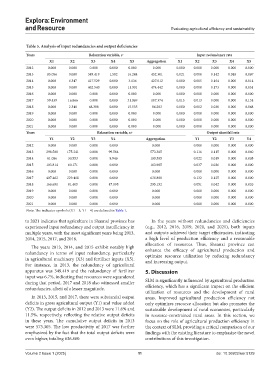
            Table 5. Analysis of input redundancies and output deficiencies
            Years                      Relaxation variable, s −                      Input redundancy rate
                      X1       X2       X3      X4      X5     Aggregation   X1     X2     X3      X4     X5
            2012     0.000    0.000    0.000    0.000   0.000     0.000     0.000  0.000   0.000  0.000  0.000
            2013     85.056   0.000   349.419   1.582  16.244    452.301    0.021  0.000   0.142  0.018  0.067
            2014     0.000    6.347   417.529   0.000   3.136    427.012    0.000  0.005   0.164  0.000  0.014
            2015     0.000    0.000   462.540   0.000  11.901    474.442    0.000  0.000   0.173  0.000  0.051
            2016     0.000    0.000    0.000    0.000   0.000     0.000     0.000  0.000   0.000  0.000  0.000
            2017     59.439   16.866   0.000    0.000  31.069    107.374    0.015  0.013   0.000  0.000  0.134
            2018     0.000    2.340    68.388   0.000  15.555     86.283    0.000  0.002   0.030  0.000  0.068
            2019     0.000    0.000    0.000    0.000   0.000     0.000     0.000  0.000   0.000  0.000  0.000
            2020     0.000    0.000    0.000    0.000   0.000     0.000     0.000  0.000   0.000  0.000  0.000
            2021     0.000    0.000    0.000    0.000   0.000     0.000     0.000  0.000   0.000  0.000  0.000
            Years                         Relaxation variable, s+                        Output shortfall rate
                      Y1       Y2       Y3      Y4             Aggregation          Y1     Y2      Y3     Y4
            2012     0.000    0.000    0.000    0.000             0.000            0.000   0.000  0.000  0.000
            2013     298.500  175.241  0.000   99.564            573.305           0.116   0.115  0.000  0.060
            2014     61.086   30.553   0.000    8.946            100.585           0.022   0.019  0.000  0.005
            2015     103.814  60.171   0.000    0.000            163.985           0.037   0.036  0.000  0.000
            2016     0.000    0.000    0.000    0.000             0.000            0.000   0.000  0.000  0.000
            2017     407.462  229.418  0.000    0.000            636.880           0.132   0.125  0.000  0.000
            2018     166.651  81.405   0.000   47.095            295.152           0.051   0.042  0.000  0.026
            2019     0.000    0.000    0.000    0.000             0.000            0.000   0.000  0.000  0.000
            2020     0.000    0.000    0.000    0.000             0.000            0.000   0.000  0.000  0.000
            2021     0.000    0.000    0.000    0.000             0.000            0.000   0.000  0.000  0.000
            Note: The indicator symbols (X1 – 5, Y1 – 4) are defined in Table 1.

            to 2021 indicates that agriculture in Shaanxi province has   In the years without redundancies and deficiencies
            experienced input redundancy and output insufficiency in   (e.g., 2012, 2016, 2019, 2020, and 2021), both inputs
            multiple years, with the most significant years being 2013,   and outputs achieved their target efficiencies, indicating
            2014, 2015, 2017, and 2018.                        a high level of production efficiency and a reasonable
                                                               allocation of resources. Thus, Shaanxi province can
              The years 2013, 2014, and 2015 exhibit notably high
            redundancy in terms of input redundancy, particularly   enhance the efficacy of agricultural production and
                                                               optimize resource utilization by reducing redundancy
            in agricultural machinery (X3) and fertilizer inputs (X5).   and increasing output.
            For instance, in 2013, the redundancy of agricultural
            apparatus was 349.419 and the redundancy of fertilizer   5. Discussion
            input was 6.7%, indicating that resources were squandered
            during that period. 2017 and 2018 also witnessed smaller   SLM is significantly influenced by agricultural production
            redundancies, albeit of a lesser magnitude.        efficiency, which has a significant impact on the efficient
                                                               utilization of resources and the development of rural
              In 2013, 2015, and 2017, there were substantial output   areas. Improved agricultural production efficiency not
            deficits in gross agricultural output (Y1) and value added   only optimizes resource allocation but also promotes the
            (Y2). The output deficits in 2012 and 2013 were 11.6% and   sustainable development of rural economies, particularly
            11.5%,  respectively, reflecting the  relative  output deficits   in resource-constrained rural areas. In this section, we
            in these years. The cumulative output deficits in 2013   focus on the role of agricultural production efficiency in
            were 573.305. The low productivity of 2017 was further   the context of SLM, providing a critical comparison of our
            emphasized by the fact that the total output deficits were   findings with the existing literature to emphasize the novel
            even higher, totaling 636.880.                     contributions of this investigation.


            Volume 2 Issue 1 (2025)                         11                               doi: 10.36922/eer.5129

