


Page 36 - EER-2-1
P. 36
Explora: Environment
            and Resource                                                  Evaluating agricultural efficiency and sustainability


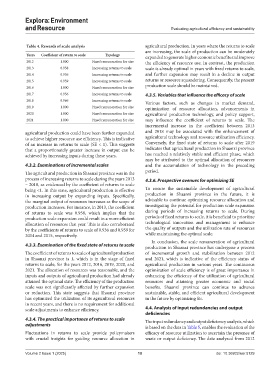
            Table 4. Rewards of scale analysis                 agricultural production. In years where the returns to scale
                                                               are increasing, the scale of production can be moderately
            Years  Coefficient of return to scale  Typology    expanded to generate higher economic benefits and improve
            2012           1.000        Fixed remuneration for size  the efficiency of resource use. In contrast, the production
            2013           0.958        Increasing returns to scale  scale is already optimal in years with fixed returns to scale,
            2014           0.936        Increasing returns to scale  and further expansion may result in a decline in output
            2015           0.959        Increasing returns to scale  returns or resource squandering. Consequently, the present
            2016           1.000        Fixed remuneration for size  production scale should be maintained.
            2017           0.956        Increasing returns to scale  4.3.5. Variables that influence the efficacy of scale
            2018           0.966        Increasing returns to scale  Various factors, such as changes in market demand,
            2019           1.000        Fixed remuneration for size  optimization  of  resource  allocation,  advancements  in
            2020           1.000        Fixed remuneration for size  agricultural production technology, and policy support,
            2021           1.000        Fixed remuneration for size  may influence the coefficient of returns to scale. The
                                                               incremental increase in the coefficient between 2013
            agricultural production could have been further expanded   and 2018 may be associated with the enhancement of
            to achieve higher resource use efficiency. This is indicative   agricultural technology and resource utilization efficiency.
            of an increase in returns to scale (SE < 1). This suggests   Conversely, the fixed state of returns to scale after 2019
            that a proportionately greater increase in output can be   indicates that agricultural production in Shaanxi province
            achieved by increasing inputs during these years.  has reached a relatively stable and efficient phase, which
                                                               may be attributed to the optimal allocation of resources
            4.3.2. Examinations of incremental scales          and the accumulation of technology in the preceding
            The agricultural production in Shaanxi province was in the   period.
            process of increasing returns to scale during the years 2013   4.3.6. Prospective avenues for optimizing SE
            – 2018, as evidenced by the coefficient of returns to scale
            being <1. In this state, agricultural production is effective   To  ensure the sustainable  development of  agricultural
            in increasing output by expanding inputs. Specifically,   production in Shaanxi province in the future, it is
            the marginal output of resources increases as the scope of   advisable to continue optimizing resource allocation and
            production increases. For instance, in 2013, the coefficient   investigating the potential for production scale expansion
            of returns to scale was 0.958, which implies that the   during periods of increasing returns to scale. During
            production scale expansion could result in a more efficient   periods of fixed returns to scale, it is beneficial to prioritize
            allocation of resources that year. This is also corroborated   technological innovation and management to enhance
            by the coefficients of returns to scale of 0.936 and 0.959 for   the quality of outputs and the utilization rate of resources
            2014 and 2015, respectively.                       while maintaining the optimal scale.
                                                                 In conclusion, the scale remuneration of agricultural
            4.3.3. Examination of the fixed state of returns to scale  production in Shaanxi province has undergone a process
            The coefficient of returns to scale of agricultural production   of  incremental  growth  and stabilization  between  2012
            in Shaanxi province is 1, which is in the stage of fixed   and 2021, which is indicative of the efficiency status of
            returns to scale, for the years 2012, 2016, 2019, 2020, and   agricultural production in various years. The continuous
            2021. The allocation of resources was reasonable, and the   optimization of scale efficiency is of great importance in
            inputs and outputs of agricultural production had already   enhancing the efficiency of the utilization of agricultural
            attained the optimal state. The efficiency of the production   resources and attaining greater economic and social
            scale was not significantly affected by further expansion   benefits. Shaanxi province can continue to advance
            or reduction. This state suggests that Shaanxi province   sustainable, stable, and efficient agricultural development
            has optimized the utilization of its agricultural resources   in the future by optimizing SE.
            in recent years, and there is no requirement for additional
            scale adjustments to enhance efficiency.           4.4. Analysis of input redundancies and output
                                                               deficiencies
            4.3.4. The practical importance of returns to scale   The input redundancy and output deficiency analysis, which
            adjustments                                        is based on the data in Table 5, enables the evaluation of the
            Fluctuations in returns to scale provide policymakers   efficacy of resource utilization to ascertain the presence of
            with crucial insights for guiding resource allocation in   waste or output deficiency. The data analyzed from 2012


            Volume 2 Issue 1 (2025)                         10                               doi: 10.36922/eer.5129

