


Page 34 - EER-2-1
P. 34
Explora: Environment
            and Resource                                                  Evaluating agricultural efficiency and sustainability


            indicates that the returns to scale are diminishing and that   4.1.5. An analysis of the overall trend
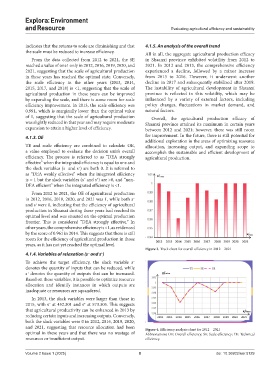
            the scale must be reduced to increase efficiency.  All in all, the aggregate agricultural production efficacy
              From the data collected from 2012 to 2021, the SE   in Shaanxi province exhibited volatility from 2012 to
            reached a value of one1 only in 2012, 2016, 2019, 2020, and   2021. In 2012 and 2013, the comprehensive efficiency
            2021, suggesting that the scale of agricultural production   experienced a decline, followed by a minor increase
            in these years has reached the optimal state. Conversely,   from 2013 to 2016. However, it underwent another
            the  scale  efficiency  in the other  years  (2013,  2014,   decline in 2017 and subsequently stabilized after 2019.
            2015, 2017, and 2018) is <1, suggesting that the scale of   The instability of agricultural development in Shaanxi
            agricultural production in these years can be improved   province is reflected in this volatility, which may be
            by expanding the scale, and there is some room for scale   influenced by a variety of external factors, including
            efficiency improvement. In 2013, the scale efficiency was   policy changes,  fluctuations in market  demand,  and
            0.991, which is marginally lower than the optimal value   natural factors.
            of 1, suggesting that the scale of agricultural production   Overall, the agricultural production efficacy of
            was slightly reduced in that year and may require moderate   Shaanxi province attained its maximum in certain years
            expansion to attain a higher level of efficiency.  between 2012 and 2021; however, there was still room

            4.1.3. OE                                          for improvement. In the future, there is still potential for
                                                               additional exploration in the areas of optimizing resource
            TE and scale efficiency are combined to calculate OE,   allocation,  increasing  output,  and  expanding  scope to
            a value employed to evaluate the decision unit’s overall   accomplish the sustainable and efficient development of
            efficiency. The  process is  referred  to as  “DEA  strongly   agricultural production.
            effective” when the integrated efficiency is equal to one and
            the slack variables (s  and s ) are both 0. It is referred to
                                  +
                             −
            as “DEA weakly effective” when the integrated efficiency
            is = 1 but the slack variables (s  and s ) are >0, and “non-
                                          +
                                     −
            DEA efficient” when the integrated efficiency is <1.
              From 2012 to 2021, the OE of agricultural production
            in 2012, 2016, 2019, 2020, and 2021 was 1, while both s
                                                          −
            and s were 0, indicating that the efficiency of agricultural
                +
            production in Shaanxi during these years had reached its
            optimal level and was situated on the optimal production
            frontier. This is considered “DEA strongly effective.” In
            other years, the comprehensive efficiency is <1, as evidenced
            by the score of 0.961 in 2014. This suggests that there is still
            room for the efficiency of agricultural production in those
            years, as it has not yet reached the optimal level.
                                                               Figure 3. Track chart for overall efficiency in 2012 – 2021
            4.1.4. Variables of relaxation (s  and s )
                                      −
                                            +
            To achieve the target efficiency, the slack variable s
                                                          −
            denotes the quantity of inputs that can be reduced, while
            s  denotes the quantity of outputs that can be increased.
             +
            Based on these variables, it is possible to optimize resource
            allocation and identify instances in which outputs are
            inadequate or resources are squandered.
              In 2013, the slack variables were larger than those in
            2015, with s  at 452.301 and s  at 573.305. This suggests
                                     +
                      −
            that agricultural productivity can be enhanced in 2013 by
            reducing certain inputs and increasing outputs. Conversely,
            both the slack variables were 0 in 2012, 2016, 2019, 2020,
            and 2021, suggesting that resource allocation had been   Figure 4. Efficiency analysis chart for 2012 – 2021
            optimal in these years and that there was no wastage of   Abbreviations: OE: Overall efficiency; SE: Scale efficiency; TE: Technical
            resources or insufficient output.                  efficiency.


            Volume 2 Issue 1 (2025)                         8                                doi: 10.36922/eer.5129

