


Page 30 - EER-2-2
P. 30
Explora: Environment
            and Resource                                                        Anabaena-Azolla for crops and bioenergy


            Table 1. Comparison of Anabaena‑Azolla with free‑living cyanobacteria
            Anabaena‑Azolla                                         Free‑living cyanobacteria         Reference
                                                                                                        (s)
            Anabaena forms a mutualistic symbiosis with the water fern   Many are free-living (e.g., Nostoc, Spirulina) or symbiotic with   13
            Azolla. Anabaena resides in cavities of Azolla leaves and fixes   different hosts, like fungi (lichens) or plant roots (Gunnera, Cycads)
            atmospheric nitrogen, benefiting the plant
            Highly efficient nitrogen-fixing system in rice paddies,   Many fix nitrogen, but often less efficiently or under specific   14
            enriching the soil with bioavailable nitrogen  conditions (e.g., heterocystous cyanobacteria such as Nostoc and
                                                       Cylindrospermum)
            Used as a biofertilizer in rice cultivation due to its   Some are used in aquaculture (Spirulina for food supplements),   15
            nitrogen-fixing ability                    whereas others contribute to harmful algal blooms (Microcystis)
            Found in freshwater wetlands and rice fields, always in   Found in a variety of habitats – terrestrial, marine, freshwater, hot   16
            association with Azolla                    springs, or even deserts
            Form heterocysts for nitrogen fixation and akinetes (spores)   Some have heterocysts (e.g., Nostoc and Cylindrospermum), but   14
            for survival, maintaining a stable symbiosis with Azolla  others (e.g., Synechococcus) lack them and fix nitrogen only under
                                                       certain conditions
            Directly benefits agriculture by enhancing soil fertility and   Some species improve soil fertility, but others may cause water   14
            reducing the need for synthetic fertilizers  pollution or toxicity (Microcystis produces harmful toxins)
            Primarily propagates through Azolla sporocarps, ensuring the   Reproduce through binary fission, hormogonia, akinetes, or   17,18
            transmission of Anabaena to the next plant generation  fragmentation

            with  the external environment through pores. 27-29  The   A       B              C
            roots are adventitious and grow vertically inside the water.
              The symbiont A. azollae is present as filaments on the
            plant’s stem apexes and in the leaf cavity. Figure 1 shows a
            single group of Anabaena. Azollae cells present in Azolla
            grown in the paddy field. Around 30% of the Anabaena
            cells differentiate into heterocysts as the leaf matures.
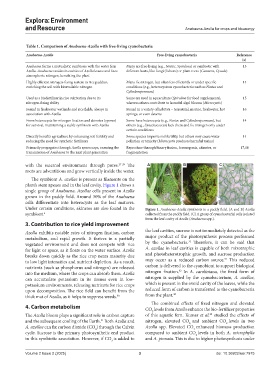
            Under certain conditions, akinetes are also found in the   Figure 1. Anabaena-Azolla symbiosis in a paddy field. (A and B) Azolla
            symbiont. 6                                        collected from the paddy field. (C) A group of cyanobacterial cells isolated
                                                               from the leaf cavity of Azolla (Anabaena spp.).
            3. Contribution to rice yield improvement
            Azolla exhibits notable rates of nitrogen fixation, carbon   the leaf cavities, sucrose is not immediately detected as the
            metabolism, and  rapid  growth.  It  thrives in  a  partially   major product of the photosynthesis process performed
                                                                                 31
            vegetated  environment  and  does  not  compete  with  rice   by the cyanobacteria.  Therefore, it can be said that
            for light or space, as it floats on the water surface. Azolla   A. azollae in leaf cavities is capable of both mixotrophic
            breaks down quickly as the rice crop nears maturity due   and photoheterotrophic growth, and sucrose production
                                                                                                31
            to low light intensities and nutrient depletion. As a result,   may  occur  as  a  reduced  carbon  source.   This  reduced
            nutrients (such as phosphorus and nitrogen) are released   carbon is delivered to the cyanobiont to support biological
                                                                             32
            into the medium, where the crops can absorb them. Azolla   nitrogen fixation.  In  A. caroliniana, the fixed form of
            can  accumulate  potassium  in its tissues even in  low-  nitrogen is supplied by the cyanobacterium,  A.  azollae,
            potassium environments, releasing nutrients for rice crops   which is present in the ovoid cavity of the leaves, while the
            upon decomposition. The rice field can benefit from the   reduced form of carbon is transferred to the cyanobacteria
            thick mat of Azolla, as it helps to suppress weeds. 30  from the plant. 30
                                                                 The combined effects of fixed nitrogen and elevated
            4. Carbon metabolism                               CO levels from Azolla enhance the bio-fertilizer properties
                                                                  2
                                                                                          33
            The Azolla bloom plays a significant role in carbon capture   of this aquatic fern. Kumar et al.  studied the effects of
            and the subsequent cooling of the Earth.  Both Azolla and   nitrogen,  elevated  CO and  ambient  CO levels  in  two
                                            21
                                                                                 2,
                                                                                                 2
            A. azollae can fix carbon dioxide (CO )through the Calvin   Azolla spp. Elevated CO enhanced biomass production
                                                                                   2
                                          2
            cycle. Sucrose is the primary photosynthetic end product   compared to ambient CO levels in both  A. microphylla
                                                                                    2
            in this symbiotic association. However, if CO is added to   and A. pinnata. This is due to higher photosynthesis under
                                                2
            Volume 2 Issue 2 (2025)                         3                                doi: 10.36922/eer.7975

