


Page 33 - EER-2-2
P. 33
Explora: Environment
            and Resource                                                        Anabaena-Azolla for crops and bioenergy


            by the enzyme dinitrogenase. Azolla receives the released   with the aid of nitrogenase. Later, the nitrogen is
            NH  from A. azollae. This NH  is an essential source of   assimilated into plants by amino acids.
               +
                                      +
                                     4
               4
            fixed nitrogen for Azolla development and survival. The
            nitrogen provided by A. azollae helps the plant become less   5.6.2. Frankia symbiosis
            reliant on outside nitrogen sources, including synthetic   Certain non-leguminous plant families have modified
            fertilizers. A. azollae provides Azolla with a sustainable and   lateral roots containing a central vascular system and a
            natural source of nitrogen, which is especially beneficial   peripheral cortex, which are infected by an actinomycetes
            in agricultural systems where  Azolla  is produced as a   called Frankia. This bacterium is associated with a variety
            green manure or cover crop to increase soil fertility and   of woody, non-legume plants belonging to the families
            reduce the need for synthetic nitrogen fertilizers. This   Betualceae, Rosaceae, Myricaceae, and Casuarinaceae, etc. 60
            rare symbiotic interaction between A. azollae and Azolla
            exemplifies the usefulness of symbiotic partnerships that   6. Biofertilizers – a replacement for
            fix nitrogen.                                      synthetic fertilizers

            5.6. Nitrogen fixation in other symbiotic microbes  To achieve maximum yield productivity, chemical
            5.6.1. Leguminous plants and Rhizobium species     fertilizers are commonly used for rapid growth. While
                                                               they can help achieve an immediate increase in yield, they
            Prokaryotes are the only organisms capable of performing   may later impose negative impacts on the surrounding
            biological  nitrogen  fixation, but  plants can  live in  a   environment. To address this problem caused by chemical
            mutualistic symbiosis with nitrogen-fixing bacteria   fertilizers, a sustainable and environmentally friendly
            and, hence, utilize the fixed form of nitrogen. This   approach is needed. This has led to the use of biofertilizers,
            type of symbiosis takes place in the leguminous plants,   which are eco-friendly in nature. 61
            specifically within the  Fabaceae family. Rhizobia are a
            group of bacteria that form specialized structures called   The term “biofertilizer” refers to mixtures of living
            nodules in leguminous plants. Some species of Rhizobium   organisms, primarily microorganisms, that increase
            found in the nodules of host plants include Rhizobium   nutrient availability through biological activity and
            leguminosarum,   Rhizobium  phaseoli,   Rhizobium   promote plant growth. These can include active or dormant
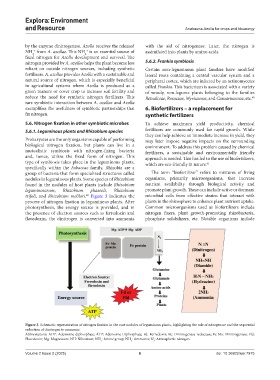
            trifoli, and  Rhizobium meliloti.   Figure  3 indicates the   microbial cells from effective strains that interact with
                                      60
            process of nitrogen fixation in leguminous plants. After   plants in the rhizosphere to enhance plant nutrient uptake.
            photosynthesis, the energy source is provided, and in   Common  microorganisms  used  as  biofertilizers  include
            the presence of electron sources such as ferredoxin and   nitrogen fixers, plant  growth-promoting  rhizobacteria,
            flavodoxin, the dinitrogen is converted into ammonia   phosphate solubilizers, etc. Notable organisms include


            Figure 3. Schematic representation of nitrogen fixation in the root nodules of leguminous plants, highlighting the role of nitrogenase and the sequential
            reduction of dinitrogen to ammonia
            Abbreviations: ADP: Adenosine diphosphate; ATP: Adenosine triphosphate; Fd: Ferredoxin; Fe: Dinitrogenase reductase; Fe-Mo: Dinitrogenase; Fld:
            Flavodoxin; Mg: Magnesium; NH: Nihonium; NH : Amine group; NH : Ammonia; N : Atmospheric nitrogen.
                                                         3
                                                                  2
                                            2
            Volume 2 Issue 2 (2025)                         6                                doi: 10.36922/eer.7975

