


Page 36 - EER-2-2
P. 36
Explora: Environment
            and Resource                                                        Anabaena-Azolla for crops and bioenergy


            for biomass production in natural ecosystems. Soluble   and actinomycetes as well as increased enzyme activity,
            phosphate constantly moves from terrestrial to aquatic   which improved the soil’s nutrient recycling ability.
                                                                                                            39
            habitats in a single direction, and most organic phosphates   Macronutrients and other minerals that reduce rice
            are not bioavailable to many species. Moreover, most   production include potassium and phosphorus. In low
            phosphates are found immobilized as calcium and iron   potassium environments,  Azolla  is particularly effective
            salts. These nutrients are typically provided to crops   at accumulating potassium in its tissues. After field water
            in the form of chemical fertilizers. 80,81  In addition, it   is drained, Azolla decomposes quickly, releasing nutrients
            has been suggested that cyanobacteria can increase the   like nitrogen, phosphorous, and potassium into the soil.
            bioavailability of phosphorus for plants using phosphatase   It also releases certain compounds, such as plant growth
            enzymes to mobilize and solubilize insoluble organic   regulators and vitamins, that enhance the growth of rice
            phosphates.  They achieve this by producing a calcium   crops and solubilizes magnesium, iron, and zinc, making
                     3
            ion  chelator  that dissolves  phosphate  compounds  while   these nutrients available to the rice crop.  The availability
                                                                                               63
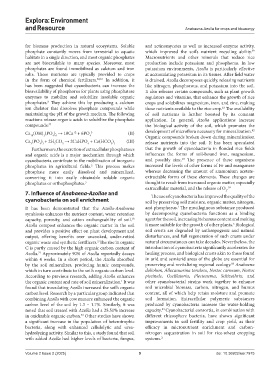
            maintaining the pH of the growth medium. The following   of soil nutrients is further boosted by its constant
            reactions release organic acids to solubilize the phosphate   application. In general,  Azolla  applications increase
            compounds: 77                                      the biological activity of the soil, which promotes the
                                                                                                            82
                                +2
            Ca (OH) (PO )  → 10Ca  + 6PO  3-           (II)    development of microflora necessary for mineralization.
              10    2  4 6             4                       Organic compounds broken down during mineralization
            Ca (PO ) + 2H CO  → 2CaHPO  + Ca(HCO )     (III)   release nutrients into the soil. It has been speculated
              3   4 2   2  3          4         3 2
              Furthermore, the excretion of extracellular phosphatases   that the growth of cyanobacteria in flooded rice fields
            and organic acids is a major mechanism through which   influences the forms of soil-bound iron, magnesium,
                                                                              18
            cyanobacteria contribute to the mobilization of inorganic   and possibly zinc.  The presence of these organisms
            phosphates in agricultural fields.  This process makes   increased the levels of other forms of Fe and manganese
                                        2
            phosphate more easily dissolved and mineralized,   whereas decreasing the amount of ammonium acetate-
            converting it into easily obtainable soluble organic   extractable forms of these elements. These changes are
            phosphates or orthophosphates. 3                   thought to result from increased organic matter, especially
                                                               extracellular material, and the release of O . 39
                                                                                                 2
            7. Influence of Anabaena-Azollae and                 The use of cyanobacteria has improved the quality of the
            cyanobacteria on soil enrichment                   soil by preserving soil moisture, organic matter, nitrogen,
                                                                             1
            It has been demonstrated that the  Azolla-Anabaena   and phosphorus.  The mucilaginous substance produced
            symbiosis enhances the nutrient content, water retention   by decomposing cyanobacteria functions as a binding
            capacity, porosity, and cation exchangeability of soil.    agent for the soil, increasing its humus content and making
                                                         18
                                                                                                    3
            Azolla compost enhances the organic matter in the soil   it more suitable for the growth of other plants.  Biological
            and provides a positive effect on plant development and   soil crusts are degraded by anthropogenic and natural
            output, offering benefits over uncooked, under-rotted   disturbances, and full regeneration of such crusts under
            organic waste and synthetic fertilizers.  The rise in organic   natural circumstances can take decades. Nevertheless, the
                                          2
            C is partly caused by the high organic carbon content of   introduction of cyanobacteria significantly accelerates the
            Azolla.  Approximately 90% of Azolla reportedly decays   healing process, and biological crusts akin to those found
                 71
            within 4  weeks. In a short period, the  Azolla  absorbed   in arid and semiarid areas of the globe are essential for
                                                                                                   83
            by the soil mineralizes, producing humic compounds,   preserving and revitalizing regional ecology.  Anabaena
            which in turn contribute to the soil’s organic carbon level.   doliolum, Allocasuarina torulosa, Nostoc carneum, Nostoc
            According to previous research, adding Azolla enhances   piscinale, Oscillatoria, Plectonema, Schizothrix, and
                                                     1
            the organic content and rate of soil mineralization.  It was   other cyanobacterial strains work  together  to  enhance
            found that inoculating Azolla increased the soil’s organic   soil microbial biomass, carbon, nitrogen, and humus
            carbon level. Research by a particular group indicated that   content, all of which help retain moisture and promote
            combining Azolla with cow manure enhanced the organic   soil formation. Extracellular polymeric substances
            carbon level of the soil by 1.3 – 1.7%. Similarly, it was   produced  by  cyanobacteria  increase  the  water-holding
            noted that soil treated with Azolla had a 25.51% increase   capacity.  Cyanobacterial consortia, in combination with
                                                                      84
            in oxidizable organic carbon.  Other studies have shown   different rhizosphere bacteria, have shown significant
                                   63
            a significant increase in the population of heterotrophic   improvements in soil fertility and crop yield, as their
            bacteria, along with enhanced cellulolytic and urea-  efficacy in micronutrient enrichment and carbon-
            hydrolyzing activity. Similar to this, a study found that soil   nitrogen sequestration in soil for rice-wheat cropping
            with added Azolla had higher levels of bacteria, fungus,   systems. 2


            Volume 2 Issue 2 (2025)                         9                                doi: 10.36922/eer.7975

