


Page 40 - EER-2-2
P. 40
Explora: Environment
            and Resource                                                        Anabaena-Azolla for crops and bioenergy


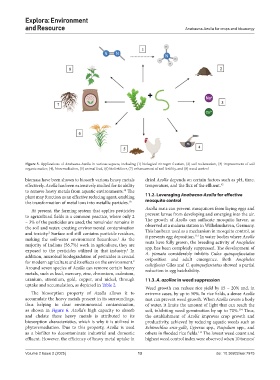
            Figure 5. Applications of Anabaena-Azolla in various aspects, including (1) biological nitrogen fixation, (2) soil reclamation, (3) improvement of soil
            organic matter, (4), bioremediation, (5) animal feed, (6) biofertilizer, (7) enhancement of soil fertility, and (8) weed control

            biomass have been shown to biosorb various heavy metals   dried Azolla depends on certain factors such as pH, time,
            effectively. Azolla has been extensively studied for its ability   temperature, and the flux of the effluent. 42
                                                      40
            to remove heavy metals from aquatic environments.  The
            plant may function as an effective reducing agent, enabling   11.2. Leveraging Anabaena-Azolla for effective
            the transformation of metal ions into metallic particles. 18  mosquito control
              At present, the farming system that applies pesticides   Azolla mats can prevent mosquitoes from laying eggs and
            to agricultural fields is a common practice, where only 2   prevent larvae from developing and emerging into the air.
            – 3% of the pesticides are used; the remainder remains in   The growth of  Azolla  can suffocate mosquito larvae, as
            the soil and water, creating environmental contamination   observed at a malaria station in Wilhelmshaven, Germany.
            and toxicity.  Surface soil still contains pesticide residues,   This has been used as a mechanism in mosquito control, as
                      2
                                                               it prevents egg deposition.  In water bodies where Azolla
                                                                                    113
            making  the soil-water  environment  hazardous.  As  the   mats have fully grown, the breeding activity of Anopheles
                                                   1
            majority of Indians (56.7%) work in agriculture, they are   spp. has been completely suppressed. The development of
            exposed to the pesticides utilized in that industry.  In   A.  pinnata considerably inhibits  Culex  quinquefasciatus
                                                       5
            addition, microbial biodegradation of pesticides is crucial   oviposition and adult emergence. Both  Anopheles
            for modern agriculture and its effects on the environment.    culicifacies Giles and C. quinquefasciatus showed a partial
                                                          2
            Around seven species of Azolla can remove certain heavy   reduction in egg hatchability.
            metals, such as lead, mercury, zinc, chromium, cadmium,
            uranium, strontium, gold, copper, and nickel, through   11.3. A. azollae in weed suppression
            uptake and accumulation, as depicted in Table 2.
                                                               Weed growth can reduce rice yield by 15 – 20% and, in
              The biosorption property of  Azolla  allows it to   extreme cases, by up to 50%. In rice fields, a dense Azolla
            accumulate the heavy metals present in its surroundings,   mat can prevent weed growth. When Azolla covers a body
            thus helping to clear environmental contamination,   of water, it limits the amount of light that can reach the
            as shown in  Figure  6.  Azolla’s high capacity to absorb   soil, inhibiting weed germination by up to 70%.  Thus,
                                                                                                       114
            and chelate these heavy metals is attributed to its   the establishment of  Azolla  improves  crop growth and
            biosorption characteristics, which is why it is utilized in   productivity, achieved by reducing aquatic weeds such as
            phytoremediation. Due to this property,  Azolla  is used   Echinochloa crus-galli,  Cyperus  spp.,  Paspalum  spp.,  and
            as a biofilter to decontaminate industrial and domestic   others in flooded rice fields.  The lowest weed count and
                                                                                     114
            effluent. However, the efficiency of heavy metal uptake in   highest weed control index were observed when 10 tonnes/

            Volume 2 Issue 2 (2025)                         13                               doi: 10.36922/eer.7975

