


Page 37 - EER-2-2
P. 37
Explora: Environment
            and Resource                                                        Anabaena-Azolla for crops and bioenergy


            8. Use of Azolla in animal feeding                 to generate electricity, power, and heat. Biofuels are
                                                               commonly extracted from the following sources: living
            The value of Azolla as animal feed is claimed to be beneficial   organisms, biomass (plants or other living organisms),
            for improving the productivity of livestock, which are a   firewood, and bio-based products/waste feedstock, such
                                      18
            crucial component of agriculture.  Azolla is a healthy feed   as bagasse. Liquid biofuels are primarily commercialized
            for animals, birds, and humans due to its high protein,   in two types: bioethanol and biodiesel. Ethanol is obtained
            amino acid, vitamins (A, B , beta carotene), calcium, iron,   from a variety of sources, ranging from starch and sugar-
                                 12
                                                       26
            phosphorus, copper, magnesium, and other minerals.  It   based crops to microorganisms such as  Saccharomyces
            also contains a low amount of lignin.  Incorporating Azolla   cerevisiae. Biodiesel was initially obtained from non-
                                        39
            into poultry feed increases broiler chicken weight without   food crops or their seeds, but it can now be produced
                                                  82
            negatively affecting production performance.  It also   in significant quantities from genetically modified
            boosts egg production in layer chickens, increasing their   microorganisms. These biofuels can be used as a blending
            ability to lay eggs by 10 – 15%. Azolla is used as feed for fish,   agent with conventional fossil fuels, such as petroleum
            pigs, rabbits, sheep, and goats. For example, milk output   or gasoline.  Biogas is also an important biofuel in its
                                                                        86
            increases by 10 – 15% in dairy animals and by 8 – 10%   gaseous form, obtained through anaerobic fermentation. It
            in goats.  Based on numerous studies and observations,   is commonly used for heating and cooking purposes. Solid
                   85
            A. pinnata is recommended as a feasible unconventional   biofuels, including charcoal, wood, and manure, are used
            protein supplement for cattle during the lean season in rain-  in rural areas for local purposes. 87
            fed areas.  A. pinnata shows that the protein in its leaves
                   18
            has favorable levels of amino acids. The use of an Azolla as   Biofuels are classified into four types based on the
            a  protein supplement can accelerate feeding, absorption,   feedstocks used: first-generation biofuels, second-
            and growth in fish. It is one of the least expensive methods   generation biofuels, third-generation biofuels, and
            for increasing fish production in organic fish farming. In   fourth-generation biofuels. The first generation biofuels
            addition, blending Azolla biomass with other agricultural   are mainly obtained from food crops. The types of fuels
            byproducts, such as wheat and rice bran, improves the   produced include bioethanol, bio-alcohol, and vegetable
                                                         82
            digestibility and protein quality of the final fish product.    oils. Commonly used food crops for the generation of
            With careful planning and cultural techniques, Azolla can   fuels include  corn, wheat, soybeans, sugar cane, beets,
            maintained year-round, ensuring its availability as fodder   wheat, rapeseed, coconut, sorghum, potato, and palm oil.
                                                                                                            88
            throughout the year. Azolla in dried form is not preferred   First-generation biofuels face a significant competitive
            by birds; thus, using fresh biomass is a better option for   disadvantage, as they require a large amount of land,
            animal and poultry feed, as it has no negative effects. 18  fertilizer, and water when it comes to food crops. In addition
                                                               to the higher costs associated with the production of
            9. Azolla as a source of food                      feedstock, first-generation fuel production can contribute

            Given that Azolla is rich in fiber, protein, fatty acids, amino   to greenhouse gas emissions. Due to these drawbacks,
                                                                                                            89
            acids, vitamins, polyphenols, and other nutritious contents,   second-generation biofuels have been developed.
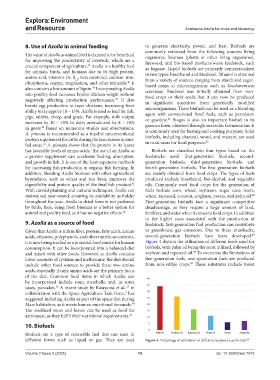
            it is now being studied as a potential food source for human   Figure 4 depicts the utilization of different feeds used for
            consumption. It can be incorporated into a balanced diet   biofuels, with palm oil being the most utilized, followed by
                                                                                   90
            and mixed with other foods. However, as Azolla contains   soybean and rapeseed oil.  To overcome the limitations of
            lower amounts of cysteine and methionine, the diet should   first-generation fuels, next-generation fuels are produced
                                                                                  89
            include other food sources to provide these two amino   from non-edible crops.  These substrates include forest
            acids, especially if only amino acids are the primary focus
            of  the diet.  Common  food  items in  which  Azolla  can
            be  incorporated  include  soup,  meatballs,  and,  in  some
                                                       27
                         42
            cases, pancakes.  A recent study by Katayama et al.,  in
            collaboration with the Space Agriculture Task Force,  has
                                                      5
            suggested including Azolla as part of the space diet during
            Mars habitation, as it meets human nutritional demands.
                                                         74
            The sterilized roots and leaves can be used as food for
            astronauts, as they fulfill their nutritional requirements. 42
            10. Biofuels
            Biofuels are a type of renewable fuel that can exist in
            different forms such as liquid or gas. They are used   Figure 4. Percentage of utilization of different feedstocks as biofuels 88

            Volume 2 Issue 2 (2025)                         10                               doi: 10.36922/eer.7975

