


Page 32 - EER-2-2
P. 32
Explora: Environment
            and Resource                                                        Anabaena-Azolla for crops and bioenergy


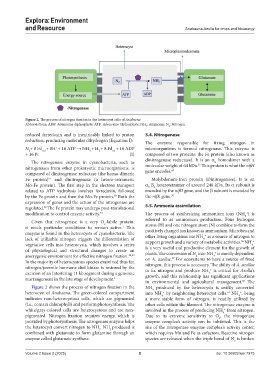
            Figure 2. The process of nitrogen fixation in the heterocyst cells of Anabaena
            Abbreviations: ADP: Adenosine diphosphate; ATP: Adenosine triphosphate; NH : Ammonia; N : Nitrogen.
                                                                         2
                                                               3
            reduced ferredoxin and is inextricably linked to proton   5.4. Nitrogenase
            reduction, producing molecular dihydrogen (Equation I):  The enzyme responsible for fixing nitrogen in

            N + 8 Fd + 8H + 16 ATP → NH + H + 8 Fd  + 16 ADP   microorganisms is termed nitrogenase. This enzyme is
                         +
                                           2
                                                 ox
                                       3
             2
                   red
            + 16 Pi                                     (I)    composed of two proteins: the Fe protein (also known as
              The  nitrogenase  enzyme  in  cyanobacteria, such as   dinitrogenase reductase). It  is an  α  homodimer with a
                                                                                            2
                                                                                     55
            nitrogenases  from  other  prokaryotic  microorganisms,  is   molecular weight of 64 kDa.  This protein is what the nifH
                                                                          45
            composed of dinitrogenase reductase (the homo-dimeric   gene encodes.
            Fe  protein)   and  dinitrogenase  (a  hetero-tetrameric   Molybdenum-Iron protein (Dinitrogenase): It is an
                      51
            Mo-Fe protein). The first step in the electron transport   α  β  heterotetramer of around 240 kDa. Its α subunit is
                                                                2
                                                                  2
            related to ATP hydrolysis involves ferredoxin, followed   encoded by the nifD gene, and the β subunit is encoded by
            by the Fe protein and then the Mo-Fe protein.  Both the   the nifK gene. 30
                                                 50
            expression of genes and the action of the nitrogenase are
            regulated.  The Fe protein may undergo post-translational   5.5. Ammonia assimilation
                    52
                                                                                                          +
            modification to control enzyme activity. 51        The process of synthesizing ammonium ions (NH ) is
                                                                                                         4
              Given that nitrogenase is a very O -labile protein,   referred to as ammonium production. Four hydrogen
                                             2
            it needs particular conditions to remain active.  This   atoms (H) and one nitrogen atom (N) combine to form the
                                                     1
            enzyme is found in the heterocysts of cyanobacteria. The   positively charged ion known as ammonium. Microbes and
                                                                                        +
            lack of utilizable nitrogen triggers the differentiation of   other living organisms use NH  as a source of nitrogen to
                                                                                       4
                                                                                                        56
                                                                                                             +
            vegetative cells into heterocysts, which involves a series   support growth and a variety of metabolic activities.  NH
                                                                                                            4
            of physiological and structural changes to create an   is a very useful and productive element for the growth of
                                                                                            +
            anoxygenic environment for effective nitrogen fixation. 53,54    plants. The conversion of N  into NH  is mostly dependent
                                                                                    2
                                                                                            4
                                                               on A. azollae.  For ecosystems to have a source of fixed
                                                                          57
            In the majority of heterocystous species examined thus far,   nitrogen, this process is necessary. The ability of A. azollae
            nitrogen/juvenile hormone diol kinase is restored by the   to fix nitrogen and produce NH  is critical for  Azolla’s
                                                                                          +
            excision of an interfering 11 kb segment during a genomic   growth, and this relationship has significant applications
                                                                                          4
            rearrangement in the late stage of development. 1
                                                               in  environmental and  agricultural  management.   The
                                                                                                        58
              Figure 2 shows the process of nitrogen fixation in the   NH  produced by the heterocysts is swiftly converted
                                                                  3
            heterocyst of Anabaena. The green-colored compartment   into NH  by neighboring heterocyst cells.  NH , being
                                                                      +
                                                                                                  59
                                                                                                       +
                                                                                                      4
                                                                      4
            indicates non-heterocystous cells, which are pigmented   a more stable form of nitrogen, is readily utilized by
            (i.e., contain chlorophyll) and perform photosynthesis. The   other cells within the filament. The nitrogenase enzyme is
            white/gray-colored  cells  are  heterocystous  and are  non-  involved in the process of producing NH  from nitrogen.
                                                                                                +
                                                                                                4
            pigmented. Nitrogen fixation requires energy, which is   Due to its extreme sensitivity to O , the nitrogenase
                                                                                              2
            provided by photosynthesis. The nitrogenase enzyme helps   enzyme complex’s activity can be inhibited. This is the
            the heterocyst convert nitrogen to NH . NH produced is   site of the nitrogenase enzyme complex’s activity center,
                                           3
                                                3
            combined with glutamate to form glutamine through an   which requires Mo and Fe as cofactors. Reactive nitrogen
            enzyme called glutamate synthase.                  species are released when the triple bond of N  is broken
                                                                                                     2
            Volume 2 Issue 2 (2025)                         5                                doi: 10.36922/eer.7975

