


Page 85 - EER-2-2
P. 85
Explora: Environment
            and Resource                                                           Critical minerals and battery recycling


                                         Figure 3. Commercialized waste battery recycling processes

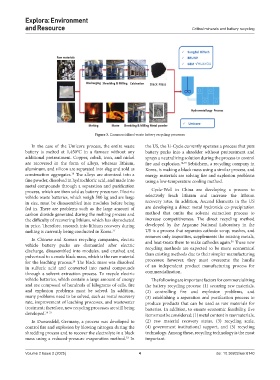
              In  the  case  of  the  Umicore  process,  the  entire  waste   the US, the Li-Cycle currently operates a process that puts
            battery is melted at 1,450°C in a furnace without any   battery packs into a shredder without pretreatment and
            additional pretreatment. Copper, cobalt, iron, and nickel   sprays a neutralizing solution during the process to control
            are recovered in the form of alloys, whereas lithium,   fire and explosion. 34,35  Sebitchem, a recycling company in
            aluminum, and silicon are separated into slag and sold as   Korea, is making a black mass using a similar process, and
            construction aggregates.  The alloys are atomized into a   energy materials are solving fire and explosion problems
                               18
            fine powder, dissolved in hydrochloric acid, and made into   using a low-temperature cooling method.
            metal compounds through a separation and purification
            process, which are then sold as battery precursor. Electric   Cycle-Well in China are developing a process to
            vehicle waste batteries, which weigh 500 kg and are large   selectively  leach lithium and  increase  the  lithium
            in size, must be disassembled into modules before being   recovery rates. In addition, Ascend Elements in the US
            fed in. There are problems such as the large amount of   are developing a direct metal hydroxide co-precipitation
            carbon dioxide generated during the melting process and   method that omits the solvent extraction process to
            the difficulty of recovering lithium, which has skyrocketed   increase competitiveness. The direct recycling method
            in price. Therefore, research into lithium recovery during   developed by the Argonne National Laboratory in the
            melting is currently being conducted in Korea. 27  US is a process that separates cathode scrap, washes, and
                                                               removes only impurities, supplements the missing metals,
              In Chinese and Korean recycling companies, electric                                  36
            vehicle battery packs are dismantled after electric   and heat-treats them to make cathodes again.  These new
            discharge, disassembled into modules, and crushed and   recycling methods are expected to be more economical
            pulverized to a create black mass, which is the raw material   than existing methods due to their simpler manufacturing
            for the leaching process.  The black mass was dissolved   processes; however, they must overcome the hurdle
                                28
            in sulfuric acid and converted into metal compounds   of an independent product manufacturing process for
            through a solvent extraction process. To recycle electric   commercialization.
            vehicle batteries, which contain a large amount of energy   The following are important factors for commercializing
            and are composed of hundreds of kilograms of cells, fire   the battery recycling process: (1) securing raw materials,
            and explosion problems must be solved. In addition,   (2)  controlling  fire  and explosion  problems,  and
            many problems need to be solved, such as metal recovery   (3)  establishing  a  separation  and  purification  process  to
            rate, improvement of leaching processes, and wastewater   produce products that can be used as raw materials for
            treatment; therefore, new recycling processes are still being   batteries. In addition, to ensure economic feasibility, five
            developed. 29-32                                   items must be considered: (1) metal content in raw materials,

              In Duesenfeld, Germany, a process was developed to   (2)  raw  material  recovery  status,  (3)  recycling  scale,
            control fire and explosion by blowing nitrogen during the   (4) government institutional support, and (5) recycling
            shredding process and to recover the electrolyte in a black   technology. Among these, recycling technology is the most
            mass using a reduced-pressure evaporation method.  In   important.
                                                       33

            Volume 2 Issue 2 (2025)                         4                                doi: 10.36922/eer.8140

