


Page 83 - EER-2-2
P. 83
Explora: Environment
            and Resource                                                           Critical minerals and battery recycling


              The batteries used in electric vehicles comprise a   energy, there is no exhaust gas emission, thus alleviating
            single pack. The pack comprises several modules, each   air pollution problems caused by driving. In addition to
            of which comprises several cells. A  single pack weighs   electric vehicles, hydrogen fuel cell vehicles that rotate
            approximately 500 kg. Cathode materials of electric vehicle   their motor using the electricity generated when oxygen
            batteries include cobalt, nickel, and lithium, which account   and hydrogen gas in the air are converted into water with
                                                     6,7
            for >30% of the price of electric vehicle batteries.  For   the help of a catalyst in a fuel cell stack can be considered
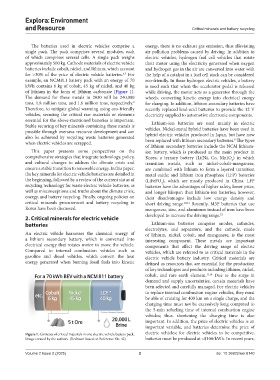
            example, an NCM811 battery pack with an energy of 70   eco-friendly. In these hydrogen electric vehicles, a battery
            kWh contains 6 kg of cobalt, 45 kg of nickel, and 40 kg   is used such that when the accelerator pedal is released
            of lithium in the form of lithium carbonate (Figure  1).   while driving, the motor acts as a generator through the
            The demand for these metals in 2030 will be 240,000   wheels,  converting  kinetic  energy  into electrical  energy
            tons, 1.8 million tons, and 1.6 million tons, respectively.    for charging. In addition, lithium secondary batteries have
                                                          8
            Therefore, to mitigate global warming using eco-friendly   recently replaced lead-acid batteries to provide the 12 V
            vehicles, securing the critical raw materials or elements   electricity supplied to automotive electronic components.
            essential for the above-mentioned batteries is important.   Lithium-ion batteries are used mainly in electric
            Stable securing of key minerals containing these metals is   vehicles. Nickel-metal hybrid batteries have been used in
            possible through overseas resource development and can   hybrid electric vehicles produced in Japan, but have now
            also be achieved by recycling waste batteries generated                                  9
            when electric vehicles are scrapped.               been replaced with lithium secondary batteries.  The types
                                                               of lithium secondary batteries include the NCM lithium-
              This paper presents some perspectives on the     ion battery, which is produced as the main product in
            comprehensive strategies that integrate technology, policy,   Korea; a ternary battery (Li(Ni, Co, Mn)O ) in which
                                                                                                    2
            and cultural changes to address the climate crisis and   transition metals, such as nickel-cobalt-manganese,
            ensure a stable transition to renewable energy. In this paper,   are combined with lithium to form a layered transition
            the key minerals for electric vehicle batteries are detailed in   metal oxide; and lithium iron phosphate (LFP) batteries
            the beginning, followed by a review of the current status of   (LiFePO ),  which  are  mostly  produced  in  China.  LFP
                                                                      4
            recycling technology for waste electric vehicle batteries, as   batteries have the advantages of higher safety, lower price,
            well as misconceptions and truths about the climate crisis,   and  longer lifespan than  lithium-ion batteries;  however,
            energy, and battery recycling. Finally, ongoing policies on   their disadvantages include low energy density and
            critical minerals procurement and battery recycling in   short driving range. 10,11  Recently, M3P batteries that use
            Korea have been discussed.                         manganese, zinc, and aluminum instead of iron have been

            2. Critical minerals for electric vehicle          developed to increase the driving range. 12
            batteries                                            Lithium-ion batteries comprise anodes, cathodes,
                                                               electrolytes, and separators, and the cathode, made
            An electric vehicle harnesses the chemical energy of   of  lithium,  nickel,  cobalt, and  manganese,  is  the  most
            a lithium secondary battery, which is converted into   interesting component. These metals are important
            electrical energy that rotates motor to move the vehicle.   components that affect the driving range of electric
            Compared to internal combustion vehicles such as   vehicles, which are referred to as critical materials in the
            gasoline and diesel vehicles, which convert the heat   electric vehicle battery industry. Critical materials are
            energy generated when burning fossil fuels into kinetic   defined as resources that are essential for the production
                                                               of key technologies and products including lithium, nickel,
                                                               cobalt,  and rare  earth element. 13,14  Due to  the surge in
                                                               demand and supply uncertainties, certain materials have
                                                               been selected and carefully managed. For electric vehicles
                                                               to replace internal combustion engine vehicles, they must
                                                               be able of cruising for 400 km on a single charge, and the
                                                               charging time must not be excessively long compared to
                                                               the 5-min refueling time of internal combustion engine
                                                               vehicles; thus, shortening the charging time is also
                                                               important. In addition, the price of electric vehicles is an
                                                               important variable, and batteries determine the price of
            Figure 1. Contents of critical materials in one electric vehicle battery pack.   electric vehicles; for electric vehicles to be competitive,
            Image created by the authors. (Redrawn based on Reference No. 42).  batteries must be produced at <$100/kWh. In recent years,


            Volume 2 Issue 2 (2025)                         2                                doi: 10.36922/eer.8140

