


Page 86 - EER-2-2
P. 86
Explora: Environment
            and Resource                                                           Critical minerals and battery recycling


            4. Misconceptions and truths about climate         by processing minerals, can also be called critical raw
            crisis, energy, and battery recycling              materials.

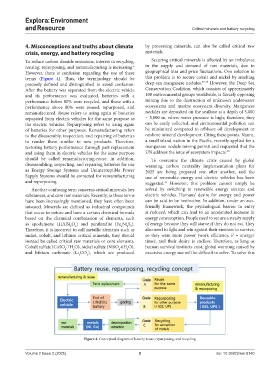
            To reduce carbon dioxide emissions, interest in recycling,   Securing critical minerals is affected by an imbalance
            reusing, repurposing, and remanufacturing is increasing.    in the supply and demand of raw materials, due to
                                                          6
            However, there is confusion regarding the use of these   geographical bias and price fluctuations. One solution to
            terms (Figure  4). Thus, the terminology should be   this problem is to secure cobalt and nickel by smelting
            precisely defined and distinguished to avoid confusion.   deep-sea manganese nodules. 37-39  However, the Deep Sea
            After the battery was separated from the electric vehicle   Conservation Coalition, which consists of approximately
            and its performance was evaluated, batteries with a   100 environmental groups worldwide, is fiercely opposing
            performance below 80% were recycled, and those with a   mining due to the destruction of unknown underwater
            performance above 80% were reused, repurposed, and   ecosystems and marine ecosystem diversity. Manganese
            remanufactured. Reuse refers to using again of batteries   nodules are deposited on the seafloor at a depth of 3,000
            separated from electric vehicles for the same purpose as   – 5,000 m, where water pressure is high; therefore, they
            the  electric  vehicles.  Repurposing  refers  to  using  again   can be easily collected, and environmental pollution can
            of batteries for other purposes. Remanufacturing refers   be minimized compared to offshore oil development or
            to the disassembly, inspection, and repairing of batteries   onshore mineral development. Citing these points, Nauru,
            to render them similar to new products. Therefore,   a small island nation in the Pacific, recently applied for a
            restoring battery performance through part replacement   manganese nodule mining permit and requested that the
            and using them in electric vehicles for the same purpose   UN address the issue of ecosystem impacts. 40
            should be called remanufacturing-reuse. In addition,   To overcome the climate crisis caused by global
            disassembling, inspecting, and repairing batteries for use   warming, carbon neutrality implementation plans for
            as Energy Storage Systems and Uninterruptible Power   2025 are being prepared one after another, and the
            Supply Systems should be corrected for remanufacturing   use of renewable energy and electric vehicles has been
            and repurposing.                                   suggested.  However, this problem cannot simply be
                                                                       41
              Another confusing term concerns critical minerals, key   solved by switching to renewable energy sources and
            substances, and core raw materials. Recently, as these terms   electric vehicles. Humans’ desire for energy and power
            have been increasingly mentioned, they have often been   can be said to be instinctive. In addition, under an eco-
            misused. Minerals are defined as industrial compounds   friendly framework, the psychological barrier to entry
            that occur in nature and have a certain chemical formula   is reduced, which can lead to an accelerated increase in
            based  on  the  chemical  combination  of  elements,  such   energy consumption. People need to secure a steady supply
            as spodumene (LiAlSi O ) and pentlandite (Fe Ni S ).   of energy because they will starve if they do not eat. They
                                                    6
                                                       3 8
                                 6
                               2
            Therefore, it is incorrect to call metallic elements such as   also need to fight and win against their enemies to survive,
            nickel, cobalt, and lithium critical minerals, they should   so they want more power (work efficiency, P = energy/
            instead be called critical raw materials or core elements.   time), and their desire is endless. Therefore, as long as
            Cobalt sulfate (CoSO ·7H O), nickel sulfate (NiSO ·6H O),   human survival instincts exist, global warming caused by
                                                    4
                                                       2
                                2
                             4
            and lithium carbonate (Li CO ), which are produced   excessive energy use will be difficult to solve. To solve this
                                   2  3


                                     Figure 4. Conceptual diagram of battery reuse, repurposing, and recycling


            Volume 2 Issue 2 (2025)                         5                                doi: 10.36922/eer.8140

