


Page 123 - EER-2-3
P. 123
Explora: Environment
            and Resource                                                          Low-cost hydroponic for chili production


            1 h.  Sterilized seeds (n = 100) were placed in plantation   necessary by adding water or nutrients. Both hydroponic
               26
            trays containing coco peat as the growth medium and were   systems were maintained indoors under natural sunlight
            watered periodically. A  control group was maintained   on an open laboratory balcony at Adamas University,
            by planting seeds in soil obtained from a local nursery.   with a temperature of 22–27°C, relative humidity (RH) of
            Germination  percentage  was  recorded  through  regular   75–80%, and light intensity of 1,000–3,000 µmol/m /s for
                                                                                                        2
            observations.  After  10  days,  healthy  seedlings  (4–5  cm   approximately 11–13 h/day. A soil-based system (n = 20)
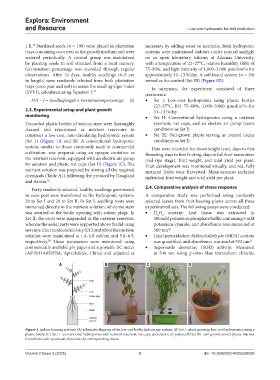
            in length) were randomly selected from both plantation   served as the control (Set III) (Figure 1D).
            trays (coco peat and soil) to assess the seedling vigor index   In summary, the experiment consisted of three
            (SVI-I), calculated using Equation I: 27           treatments:
              SVI – I = Seedlinglength × Germinationpercentage  (I)  •   Set I: Low-cost hydroponics using plastic bottles
                                                                  (22–27°C, RH 75–80%, 1,000–3,000  µmol/m /s for
                                                                                                        2
            2.3. Experimental setup and plant growth              11–13 h/day
            monitoring                                         •   Set II: Conventional hydroponics using a nutrient
            Discarded plastic bottles of various sizes were thoroughly   reservoir, net cups, and an electric air pump (same
            cleaned  and repurposed  as  nutrient  reservoirs to   conditions as Set I)
            construct a low-cost, non-circulating hydroponic system   •   Set III: Soil-grown plants serving as control (same
            (Set I) (Figure  1A and  B). A  conventional hydroponic   conditions as Set I).
            system, similar to those commonly used in commercial   Data were recorded for shoot height (cm), days to first
            cultivation, was prepared using an opaque container as   flowering, days to first fruiting, days to full fruit maturation
            the nutrient reservoir, equipped with an electric air pump   (red-ripe stage), fruit weight, and total yield per plant.
            for aeration and plastic net cups (Set II) (Figure 1C). The   Fruit development was monitored visually, and red, fully
            nutrient solution was prepared by mixing all the required   matured fruits were harvested. Measurements included
            chemicals (Table A1) following the protocol by Hoagland   individual fruit weight and total yield per plant.
            and Arnon. 28

              Forty randomly selected, healthy seedlings germinated   2.4. Comparative analysis of stress response
            in coco peat were transferred to the hydroponic systems:   A comparative study was performed using randomly
            20 to Set I and 20 to Set II. In Set I, seedling roots were   selected leaves from fruit-bearing plants across all three
            immersed directly in the nutrient solution, while the stem   experimental sets. The following assays were conducted:
            was secured at the  bottle opening  with cotton plugs. In   •   H O  content:  Leaf tissue was  extracted in
                                                                      2
                                                                    2
            Set II, the roots were suspended in the nutrient reservoir,   100 mM potassium phosphate buffer containing 5 mM
            whereas the aerial parts were supported above the lid using   potassium cyanide, and absorbance was measured at
            net cups. Electrical conductivity (EC) and pH of the nutrient   560 nm 30
            solution were maintained at 1.4–1.8 mS/cm and 5.8–6.5,   •   Lipid peroxidation: Malondialdehyde (MDA) content
                     29
            respectively.  These parameters were monitored using   was quantified, and absorbance was read at 532 nm 31
            commercially available pH paper and a portable EC meter   •   Superoxide dismutase (SOD) activity: Measured
            (AP-IS11A058FBA, Aptechdeals, China) and adjusted as   at  540  nm  using  p-nitro  blue  tetrazolium  chloride


                          A                   B                C                 D


            Figure 1. Indoor farming systems: (A) schematic diagram of the low-cost bottle hydroponic system; (B) Set I - plant grown in low-cost hydroponics using a
            plastic bottle; (C) Set II - conventional hydroponics with nutrient reservoir, net cups, and electric air pump; (D) Set III - soil-grown control plants. Harvest
            fruits from each system are shown in the corresponding insets.


            Volume 2 Issue 3 (2025)                         3                           doi: 10.36922/EER025250050

