


Page 124 - EER-2-3
P. 124
Explora: Environment
            and Resource                                                          Low-cost hydroponic for chili production


               (NBT). One unit of SOD activity was defined as the   3. Results
               amount of enzyme required to inhibit 50% of NBT
               photoreduction 32                               3.1. Evaluation of seedling growth potential
            •   Catalase (CAT) activity: Leaf extracts were prepared in   Randomly selected seeds from the stock were viable and
               the presence of 50 mM phosphate buffer and 20 mM   demonstrated promising germination in plantation trays
               H O , and absorbance was monitored at 240 nm. One   with both soil and coco peat as substrates. However, seeds
                   2
                 2
               unit  of  CAT  activity  was  defined  as  the  amount  of   raised in coco peat exhibited slightly higher germination
               H O  decomposed (in µmol) per minute. 33        performance (80% in soil vs. 100% in coco peat). After
                 2
                   2
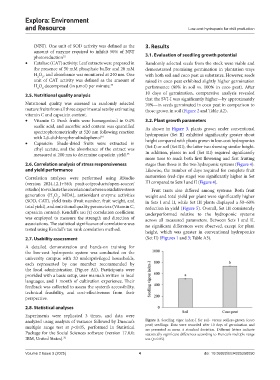
            2.5. Nutritional quality analysis                  10  days of germination, comparative analysis revealed
                                                               that the SVI-I was significantly higher—by approximately
            Nutritional quality was assessed in randomly selected   70%—in seeds germinated in coco peat in comparison to
            mature fruits from all three experimental sets by estimating   those grown in soil (Figure 2 and Table A2).
            vitamin C and capsaicin content.
            •   Vitamin C: Fresh fruits were homogenized in 0.4%   3.2. Plant growth parameters
               oxalic acid, and ascorbic acid content was quantified   As shown in  Figure  3, plants grown under conventional
               spectrophotometrically at 520 nm following reaction   hydroponics (Set II) exhibited significantly greater shoot
               with 2,6-dichlorophenolindophenol 34
            •   Capsaicin:  Shade-dried  fruits  were  extracted  in   height compared with plants grown in low-cost hydroponics
               ethyl acetate, and the absorbance of the extract was   (Set I) or soil (Set III), the latter two showing similar height.
               measured at 280 nm to determine capsaicin yield. 35  In addition, plants in soil (Set III) required significantly
                                                               more time to reach both first flowering and first fruiting
            2.6. Correlation analysis of stress responsiveness   stages than those in the two hydroponic systems (Figure 4).
            and yield performance                              Likewise, the number of days required for complete fruit
            Correlation analyses were performed using RStudio   maturation (red-ripe stage) was significantly higher in Set
            (version  2024.12.1+563; posit.co/products/open-source/  III compared to Sets I and II (Figure 4).
            rstudio) to evaluate the correlations between oxidative stress   Fruit traits also differed among systems: Both fruit
            generation (H O , MDA), antioxidant enzyme activities   weight and total yield per plant were significantly higher
                          2
                       2
            (SOD, CAT), yield traits (fruit number, fruit weight, and   in Sets I and II, while Set III plants displayed a 50–60%
            total yield), and nutritional quality parameters (Vitamin C,   reduction in yield (Figure 5). Overall, Set III consistently
            capsaicin content). Kendall’s tau (τ) correlation coefficient   underperformed relative to the hydroponic systems
            was employed to measure the strength and direction of   across all measured parameters. Between Sets I and II,
            associations. The statistical significance of correlations was   no significant differences were observed, except for plant
            tested using Kendall’s tau rank correlation method.  height, which was greater in conventional hydroponics

            2.7. Usability assessment                          (Set II) (Figures 1 and 3; Table A3).
            A detailed demonstration and hands-on training for
            the low-cost hydroponic system was conducted on the
            university campus with 20 underprivileged households,
            each  represented by  one  member  recommended  by
            the local administration (Figure A1). Participants were
            provided with a basic setup, user manuals written in local
            languages, and 1  month of cultivation experience. Their
            feedback was collected to assess the system’s accessibility,
            technical feasibility, and cost-effectiveness from their
            perspective.

            2.8. Statistical analyses
            Experiments  were  replicated  3  times,  and  data  were
            analyzed using analysis of variance followed by Duncan’s   Figure  2. Seedling vigor index-I for soil-  versus soilless-grown (coco
            multiple range test at  p<0.05, performed in Statistical   peat) seedlings. Data were recorded after 10  days of germination and
                                                               are presented as mean ± standard deviation. Different letters indicate
            Package for the Social Sciences software (version 17.0.0;   statistically significant differences according to Duncan’s multiple range
            IBM, United States). 36                            test (p<0.05).


            Volume 2 Issue 3 (2025)                         4                           doi: 10.36922/EER025250050

