


Page 9 - EER-2-3
P. 9
Explora: Environment
            and Resource                                                         Environmental contamination of titanium


            oxidation states: Ti , Ti  (titanous), and Ti  (titanic).   carcinogenic to humans (Group  2B) on the basis of
                                3+
                            2+
                                                 4+
            Among them, Ti  and Ti  are not stable, while Ti  is   sufficient evidence in experimental animals and insufficient
                                 3+
                                                       4+
                          2+
            the most stable ionic form, which commonly exists as   evidence from epidemiological studies.” 25(p275)
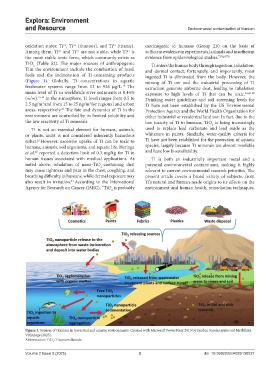
            TiO  (Table S2). The major sources of anthropogenic   Ti enters the human body through ingestion, inhalation,
               2
            Tiin the environment include the combustion of fossil   and dermal contact; fortunately, and importantly, most
            fuels and the incineration of Ti-containing products   ingested Ti is eliminated from the body. However, the
            (Figure  1). Globally, Ti concentrations in aquatic   mining of Ti ore and the industrial processing of Ti
            freshwater systems range from 12 to 926  μg/L.  The   extraction generate airborne dust, leading to inhalation
                                                     19
            mean level of Ti in worldwide river sediments is 0.44%   exposure to high levels of  Ti  that  can  be  toxic. 21,26-28
            (w/w). 15,20  In the atmosphere, Ti level ranges from 0.5 to   Drinking water guidelines and soil screening levels for
            2.5 ng/m and from 15 to 25 ng/m for regional and urban   Ti have not been established by the US Environmental
                   3
                                       3
            areas, respectively.  The fate and dynamics of Ti in the   Protection Agency and the World Health Organization for
                           21
            environment are controlled by its limited solubility and   either industrial or residential land use. In fact, due to the
            the low reactivity of Ti minerals.                 low toxicity of Ti to humans, TiO  is being increasingly
                                                                                           2
              Ti is not an essential element for humans, animals,   used to replace lead carbonate and lead oxide as the
            or plants, andit is not considered inherently hazardous   whiteners in paints. Similarly, water-quality  criteria  for
            either. However, excessive uptake of Ti can be toxic to   Ti have not been established for the protection of aquatic
                 22
            humans, animals, soil organisms, and aquatic life. Heringa   species, largely because Ti minerals are almost insoluble
            et al.  reported a detection limit of 0.3 mg/kg for Ti in   and have low bioavailability.
                23
            human tissues associated with medical applications. As   Ti is both an industrially important metal and a
            noted above, inhalation of nano-TiO -containing dust   potential  environmental  contaminant,  making  it  highly
                                            2
            may cause tightness and pain in the chest, coughing, and   relevant to current environmental research priorities. The
            breathing difficulty in humans, while dermal exposure may   present article covers a broad variety of subjects, from
            also result in irritation. According to the International   Ti’s natural and human-made origins to its effects on the
                               24
            Agency for Research on Cancer (IARC), “TiO  is probably   environment and human health, remediation techniques,
                                                2


            Figure 1. Sources of titanium in terrestrial and aquatic environments. Created with Microsoft PowerPoint 2013 by Sandun Sandanayakeand Meththika

            Vithanage(2025).

            Abbreviation: TiO : Titanium dioxide.
                       2
            Volume 2 Issue 3 (2025)                         3                           doi: 10.36922/EER025130027

