


Page 12 - EER-2-3
P. 12
Explora: Environment
            and Resource                                                         Environmental contamination of titanium


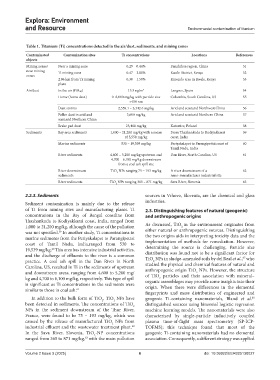
            Table 1. Titanium (Ti) concentrations detected in the air/dust, sediments, and mining zones
            Contaminated    Contamination sites      Ti concentrations            Locations          References
            objects
            Mining zones/  Near a mining zone          0.29 – 0.44%       Panzhihua region, China       51
            near mining   Ti mining zone               0.47 – 2.80%       Kwale District, Kenya         52
            zones
                          2.86 km from Ti mining       0.30 – 1.50%       Kinondo area in Kwale, Kenya  53
                          plant
            Air/dust      In the air (PM10)            15.3 ng/m 3        Langreo, Spain                54
                          Home (home dust)       0–8,000 mg/kg with particle size   Columbia, South Carolina, US  55
                                                        >450 nm
                          Dust storms              2,558.1 – 3,342.6 mg/kg  Arid and semiarid Northwest China  56
                          Fallen dust in arid and      3,600 mg/kg        Arid and semiarid Northern China  57
                          semiarid Northern China
                          Brake pad dust               25,400 mg/kg       Katowice, Poland              58
            Sediments     Bay area sediments    1,000 – 21,200 mg/kg with a mean   From Thazhankuda to Kodiyakkarai   59
                                                      of 5,550 mg/kg      coast, India
                          Marine sediments           530 – 19,539 mg/kg   Periyakalapet to Parangipettai coast of   60
                                                                          Tamil Nadu, India
                          River sediments       4,600 – 5,200 mg/kg upstream and   Dan River, North Carolina, US  61
                                                4,700 – 6,100 mg/kg downstream
                                                   from a coal ash spill site
                          River downstream      TiO  NPs ranging 75 – 193 mg/kg  A river downstream of a   62
                                                   2
                          sediments                                       nano-manufacturer industrial site
                          River sediments       TiO  NPs ranging 365 – 871 mg/kg  Sava River, Slovenia  63
                                                  2
            2.2.3. Sediments                                   sources in Vrhovo, Slovenia, are the chemical and glass
            Sediment contamination is mainly due to the release   industries.
            of  Ti from  mining  sites  and manufacturing  plants.  Ti   2.3. Distinguishing features of natural (geogenic)
            concentrations in the Bay of Bengal coastline from   and anthropogenic origins
            Thazhankuda to Kodiyakkarai coast, India, ranged from
            1,000 to 21,200 mg/kg, although the cause of the pollution   As discussed, TiO in the environment originates from
                                                                              2
            was not specified.  In another study, Ti concentrations in   either natural or anthropogenic sources. Distinguishing
                          59
            marine sediments from the Periyakalapet to Parangipettai   the two origins aids in interpreting toxicity data and the
            coast  of  Tamil  Nadu,  India,ranged  from  530  to   implementation of methods for remediation. However,
            19,539 mg/kg.  This area has intensive industrial activities,   determining the source is challenging. Particle size
                       60
            and the discharge of effluents to the river is a common   distribution was found not to be a significant factor for
                                                                                                        67
            practice. A  coal ash spill in the Dan River in North   TiO  NPs in sludge-amended soils by del Real et al.,  who
                                                                  2
                                                               studied the physical and chemical features of natural and
            Carolina, US, resulted in Ti in the sediments of upstream   anthropogenic origin TiO  NPs. However, the structure
            and downstream areas, ranging from 4,600 to 5,200 mg/  of TiO  particles and their association with mineral–
                                                                                    2
            kg and 4,700 to 6,100 mg/kg, respectively. This type of spill   organic assemblages may provide some insights into their
                                                                     2
            is significant as Ti concentrations in the sediments were   origin. When there were differences in the elemental
            similar to those in coal ash. 61
                                                               fingerprints and mass distribution of engineered and
              In addition to the bulk form of TiO , TiO  NPs have   geogenic Ti-containing nanomaterials, Bland  et al.
                                                                                                            68
                                            2
                                                 2
            been detected in sediments. The concentrations of TiO    distinguished sources using binomial logistic regression
                                                          2
            NPs in the sediment downstream of the Thur River,   machine learning models. The nanomaterials were also
            France, were found to be 75 – 193  mg/kg, which was   characterized by single-particle inductively coupled
            caused by the release of manufactured TiO  NPs from   plasma time-of-flight mass spectrometry (SP-ICP-
                                                 2
            industrial effluent and the wastewater treatment plant.    TOFMS); this technique found that most of the
                                                         62
            In the Sava River, Slovenia, TiO -NP concentrations   geogenic Ti-containing nanomaterials had no elemental
                                         2
            ranged from 365 to 871 mg/kg,  with the main pollution   association. Consequently, a different strategy was applied
                                     63
            Volume 2 Issue 3 (2025)                         6                           doi: 10.36922/EER025130027

