


Page 14 - EER-2-3
P. 14
Explora: Environment
            and Resource                                                         Environmental contamination of titanium


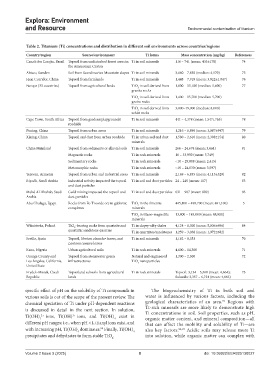
            Table 2. Titanium (Ti) concentrations and distribution in different soil environments across countries/regions
            Country/region          Source/environment         Ti forms       Mass concentration (mg/kg)  References
            Canaã dos Carajàs, Brazil  Topsoil from undisturbed forest areas in  Ti in soil minerals  116 – 741 (mean: 433±178)  74
                              the Amazonian Craton
            Abisco, Sweden    Soil from Scandinavian Mountain slopes Ti in soil minerals  3,660 – 7,830 (median: 4,170)  75
            Hexi Corridor, China  Topsoil from farmlands  Ti in soil minerals  1,448 – 7,919 (mean: 3,022±1,047)  76
            Europe (33 countries)  Topsoil from agricultural lands  TiO  in soil derived from   1,800 – 55,100 (median: 5,600)  77
                                                            2
                                                         granite rocks
                                                         TiO  in soil derived from   1,400 – 15,700 (median: 5,700)
                                                            2
                                                         gneiss rocks
                                                         TiO  in soil derived from   3,000–19,900 (median: 8,000)
                                                            2
                                                         schist rocks
            Cape Town, South Africa  Topsoil from gardens/playgrounds/  Ti in soil minerals  441 – 4,378 (mean: 1,547±765)  78
                              roadside
            Puning, China     Topsoil from urban areas   Ti in soil minerals  1,216 – 6,896 (mean: 3,087±947)  79
            Xining, China     Topsoil and dust from urban roadside  Ti in urban soil and dust   1,580 – 2,610 (mean: 2,308±154)  80
                                                         minerals
            China Mainland    Topsoil from sediments or alluvial soils  Ti in soil minerals  266 – 24,674 (mean: 3,661)  81
                              Magmatic rocks             Ti in rock minerals  16 – 33,950 (mean: 3,749)
                              Sedimentary rocks          Ti in rock minerals  <10 – 29,888 (mean: 2,415)
                              Metamorphic rocks          Ti in rock minerals  <10 – 24,030 (mean: 3,597)
            Yerevan, Armenia  Topsoil from urban and industrial areas  Ti in soil minerals  2,169 – 6,835 (mean: 4,115±529)  82
            Riyadh, Saudi Arabia  Industrial activity impacted the topsoil   Ti in soil and dust particles 24 – 240 (mean: 117)  83
                              and dust particles
            Mahd Al Dhahab, Saudi   Gold mining impacted the topsoil and   Ti in soil and dust particles 631 – 987 (mean: 809)  83
            Arabia            dust particles
            Abu Ghalaga, Egypt  Rocks from Fe-Ti oxide ore in gabbroic  TiO  in the ilmenite   445,100 – 490,700 (mean: 481,100)  5
                                                            2
                              complexes                  minerals
                                                         TiO  in titano-magnetite   13,800 – 185,000 (mean: 88,800)
                                                            2
                                                         minerals
            Wiśniówka, Poland  TiO -bearing rocks from quartzite and   Ti in clayey-silty shales  4,124 – 6,300 (mean: 5,036±696)  84
                                 2
                              quartzitic sandstone quarries  Ti in quartzites/sandstones 1,259 – 3,038 (mean: 1,972±682)
            Seville, Spain    Topsoil, Nerium oleander leaves, and   Ti in soil minerals  1,162 – 8,353  70
                              Lantana camara leaves
            Kano, Nigeria     Urban agricultural soils   Ti in rock minerals  4,600 – 14,300            71
            Orange County and   Topsoil from stormwater green   Natural and engineered   1,300 – 2,500  72
            Los Angeles, California,   infrastructures   TiO  nanoparticles
                                                            2
            United State
            Frydek-Mistek, Czech   Topsoiland subsoils from agricultural   Ti in rock minerals  Topsoil: 3,134 – 5,560 (mean: 4,664);  73
            Republic          lands                                         Subsoils: 3,357 – 6,724 (mean: 4,863)

            specific effect of pH on the solubility of Ti compounds in   The  biogeochemistry  of  Ti  in  both  soil  and
            various soils is out of the scope of the present review. The   water is influenced by various factors, including the
                                                                                                91
            chemical speciation of Ti under pH-dependent reactions   geological characteristics of an area.  Regions with
            is  discussed  in  detail  in  the  next  section.  In  solution,   Ti-rich minerals are more likely to demonstrate high
            Ti(OH) 2 2+   ions, Ti(OH) 3+   ions, and Ti(OH)  exist in   Ti concentrations in soil. Soil properties, such as pH,
                                                               organic matter content, and mineral composition—all
                                                  4
            different pH ranges; i.e., when pH <1, titanyl ions exist, and   that can affect the mobility and solubility of Ti—are
            with increasing pH, Ti(OH)  dominates.  Finally, Ti(OH)    also  key  factors. 92,93   Acidic  soils  may  release  more  Ti
                                            90
                                  4
                                                          4
            precipitates and dehydrates to form stable TiO .   into solution, while organic matter can complex with
                                                 2
            Volume 2 Issue 3 (2025)                         8                           doi: 10.36922/EER025130027

