


Page 144 - EJMO-9-1
P. 144
Eurasian Journal of Medicine and
            Oncology
                                                                        Machine learning insights into heart failure outcomes


            adverse outcomes in HF. The comprehensive assessment   likelihood of death events. Furthermore, the matrix
            of attribute importance provides valuable insights for   highlights the presence of both positive and negative
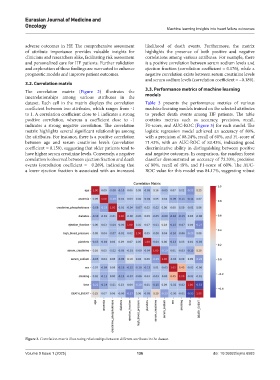
            clinicians and researchers alike, facilitating risk assessment   correlations among various attributes. For example, there
            and personalized care for HF patients. Further validation   is a positive correlation between serum sodium levels and
            and exploration of these findings are warranted to enhance   ejection fraction (correlation coefficient = 0.176), while a
            prognostic models and improve patient outcomes.    negative correlation exists between serum creatinine levels
                                                               and serum sodium levels (correlation coefficient = −0.189).
            3.2. Correlation matrix

            The correlation matrix (Figure  2) illustrates the   3.3. Performance metrics of machine learning
            interrelationships among various attributes in the   models
            dataset. Each cell in the matrix displays the correlation   Table 3 presents the performance metrics of various
            coefficient between two attributes, which ranges from -1   machine learning models trained on the selected attributes
            to 1. A correlation coefficient close to 1 indicates a strong   to predict death events among HF patients. The  table
            positive correlation, whereas a coefficient close to  -1   contains  metrics  such as  accuracy, precision,  recall,
            indicates a strong negative correlation. The correlation   F1-score, and AUC-ROC (Figure 3) for each model. The
            matrix highlights several significant relationships among   logistic regression model achieved an accuracy of 80%,
            the attributes. For instance, there is a positive correlation   with a precision of 88.24%, recall of 60%, and F1-score of
            between age and serum creatinine levels (correlation   71.43%, with an AUC-ROC of 83.43%, indicating good
            coefficient = 0.159), suggesting that older patients tend to   discriminative  ability  in  distinguishing  between  positive
            have higher serum creatinine levels. Conversely, a negative   and negative outcomes. In comparison, the random forest
            correlation is observed between ejection fraction and death   classifier demonstrated an accuracy of 73.33%, precision
            events (correlation coefficient = −0.269), indicating that   of 80%, recall of 48%, and F1-score of 60%. The AUC-
            a lower ejection fraction is associated with an increased   ROC value for this model was 84.17%, suggesting robust


            Figure 2. Correlation matrix illustrating relationships between different attributes in the dataset


            Volume 9 Issue 1 (2025)                        136                              doi: 10.36922/ejmo.6583

