


Page 145 - EJMO-9-1
P. 145
Eurasian Journal of Medicine and
            Oncology
                                                                        Machine learning insights into heart failure outcomes


            Table 3. Performance metrics of various machine learning
            models trained on the selected attributes to predict death
            events among heart failure patients

            Performance   Logistic   Random   Support   Gradient
            metric      regression  forest  vector   boosting
                                          machine  machine
            Accuracy      0.80     0.73     0.58     0.73
            Precision     0.88     0.80     0.00     0.76
            Recall        0.60     0.48     0.00     0.52
            F1-score      0.71     0.60     0.00     0.61
            AUC-ROC       0.83     0.84     0.52     0.88
            Abbreviation: AUC-ROC: Area under the curve of the receiver
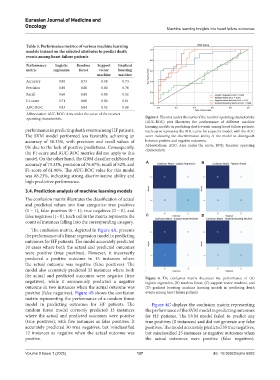
            operating characteristic.                          Figure 3. The area under the curve of the receiver operating characteristic
                                                               (AUC-ROC) plot illustrates the performance of different machine
                                                               learning models in predicting death events among heart failure patients.
            performance in predicting death events among HF patients.   Each curve represents the ROC curve for a specific model, with the AUC
            The SVM model performed less favorably, achieving an   score indicating the discriminative ability of the model to distinguish
            accuracy of 58.33%, with precision and recall values of   between positive and negative outcomes.
            0% due to the lack of positive predictions. Consequently,   Abbreviations: AOC: Area under the curve; ROC: Receiver operating
                                                               characteristic
            the F1-score and AUC-ROC metrics did not apply to this
            model. On the other hand, the GBM classifier exhibited an
            accuracy of 73.33%, precision of 76.47%, recall of 52%, and   A            B
            F1-score of 61.90%. The AUC-ROC value for this model
            was 88.23%, indicating strong discriminative ability and
            high predictive performance.

            3.4. Prediction analysis of machine learning models
            The confusion matrix illustrates the classification of actual
            and predicted values into four categories: true positives
            (1 – 1), false positives (0 – 1), true negatives (0 – 0), and
            false negatives (1– 0). Each cell in the matrix represents the   C         D
            count of instances falling into the corresponding category.
              The confusion matrix, depicted in Figure 4A, presents
            the performance of a linear regression model in predicting
            outcomes for HF patients. The model accurately predicted
            10 cases where both the actual and predicted outcomes
            were positive (true positives). However, it incorrectly
            predicted a positive outcome in 15 instances where
            the actual outcome was negative (false positives). The
            model also accurately predicted 33 instances where both
            the  actual  and  predicted  outcomes  were  negative  (true   Figure  4. The confusion matrix illustrates the performance of (A)
            negatives), while it erroneously predicted a negative   logistic regression, (B) random forest, (C) support vector machine, and
            outcome in two instances when the actual outcome was   (D) gradient boosting machine learning models in predicting death
            positive (false negatives). Figure 4B shows the confusion   events among heart failure patients
            matrix representing the performance of a random forest
            model in predicting outcomes for HF patients. The    Figure 4C displays the confusion matrix representing
            random forest model correctly predicted 13 instances   the performance of the SVM model in predicting outcomes
            where the actual and predicted outcomes were positive   for HF patients. The SVM model failed to predict any
            (true positives), with five instances as false positives. It   true positives (0 instances) and did not generate any false
            accurately  predicted 30  true negatives, but misclassified   positives. The model accurately predicted 35 true negatives,
            12 instances as negative when the actual outcome was   but misclassified 25 instances as negative outcomes when
            positive.                                          the actual outcomes were positive (false negatives).


            Volume 9 Issue 1 (2025)                        137                              doi: 10.36922/ejmo.6583

