


Page 139 - EJMO-9-1
P. 139
Eurasian Journal of Medicine and
            Oncology
                                                                             Oncology care with AI chatbots and assistants


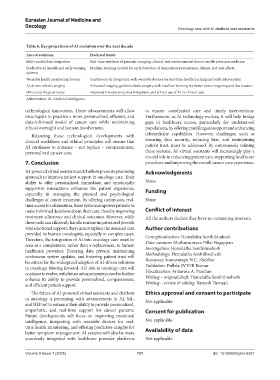
            Table 6. Key projections of AI evolution over the next decade
            Area of evolution          Predicted trends
            Multi-modal data integration  Real-time synthesis of genomic, imaging, clinical, and environmental data to enable precision medicine.
            Predictive AI models and early warning  Machine learning models for early detection of chemotherapy resistance, relapse, and side effects.
            systems
            Wearable health monitoring devices  Continuous AI integration with wearable devices for real-time health tracking and early intervention.
            AI-driven robotic surgery  Enhanced imaging-guided robotic surgery with machine learning for better tumor targeting and less trauma.
            Ethics and AI governance   Improved transparency, bias mitigation, and ethical use of AI in clinical care.
            Abbreviation: AI: Artificial intelligence.

            technological innovation. These advancements will allow   to  ensure  coordinated  care  and  timely interventions.
            oncologists to practice a more personalized, efficient, and   Furthermore, as AI technology evolves, it will help bridge
            data-informed model of cancer care while maintaining   gaps in healthcare access, particularly for underserved
            ethical oversight and human involvement.           populations, by offering multilingual support and enhancing
              Balancing these technological developments with   telemedicine capabilities. However, challenges, such as
            clinical workflows and ethical principles will ensure that   ensuring data security, reducing bias, and maintaining
            AI continues to enhance – not replace – compassionate,   patient trust, must be addressed. By continuously refining
            personalized cancer care.                          these systems, AI virtual assistants will increasingly play a
                                                               crucial role in enhancing patient care, supporting healthcare
            7. Conclusion                                      providers, and improving the overall cancer care experience.

            AI-powered virtual assistants and chatbots present a promising   Acknowledgments
            approach to improve patient support in oncology care. Their
            ability to offer personalized, immediate, and emotionally   None.
            supportive interactions enhances the patient experience,   Funding
            especially in  managing  the physical and psychological
            challenges of cancer treatment. By offering continuous, real-  None.
            time access to information, these systems empower patients to
            make informed decisions about their care, thereby improving   Conflict of interest
            treatment adherence and clinical outcomes. However, while   All the authors declare they have no competing interests.
            these tools can efficiently handle routine inquiries and provide
            vital emotional support, they cannot replace the nuanced care   Author contributions
            provided by human oncologists, especially in complex cases.   Conceptualization: Hemalatha Senthilmahesh
            Therefore, the integration of AI into oncology care must be
            seen as a complement, rather than a replacement, to human   Data curation: Muthuvairavan Pillai Nagappan
            healthcare  providers.  Ensuring  data  privacy,  maintaining   Investigation: Hemalatha Senthilmahesh
            continuous system updates, and fostering patient trust will   Methodology: Hemalatha Senthilmahesh
                                                               Resources: Somavarapu N.C. Shekhar
            be critical for the widespread adoption of AI-driven solutions
            in oncology. Moving forward, AI’s role in oncology care will   Validation: Pullela SVVSR Kumar
            continue to evolve, with future advancements poised to further   Visualization: Anbarasa A. Pandian
            enhance its  ability  to  provide personalized, compassionate,   Writing – original draft: Hemalatha Senthilmahesh
            and efficient patient support.                     Writing – review & editing: Ramesh Tumaati
              The future of AI-powered virtual assistants and chatbots   Ethics approval and consent to participate
            in oncology is promising, with advancements in AI, ML,   Not applicable.
            and NLP set to enhance their ability to provide personalized,
            empathetic, and real-time support for cancer patients.   Consent for publication
            Future developments  will focus on  improving emotional
            intelligence, integrating with wearable devices for real-  Not applicable.
            time health monitoring, and offering predictive insights for   Availability of data
            better symptom management. AI systems will also be more
            seamlessly integrated with healthcare provider platforms   Not applicable.


            Volume 9 Issue 1 (2025)                        131                              doi: 10.36922/ejmo.6251

