


Page 154 - EJMO-9-1
P. 154
Eurasian Journal of Medicine and
            Oncology
                                                                               Potential of flavonoids against glioblastoma


            2. Methods

            2.1. Plant collection
            The bark of  P. chinensis was collected from the area
            surrounding Hostel 02 at the University of Peshawar,
            Khyber Pakhtunkhwa, Pakistan. To ensure the authenticity
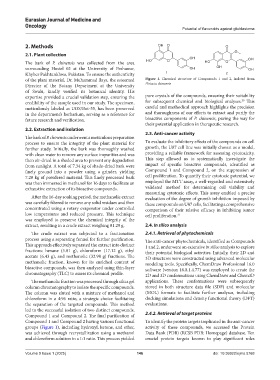
            of the plant material, Dr. Muhammad Ilays, the esteemed   Figure  1.  Chemical structure of Compounds 1 and 2, isolated from
            Director of the Botany Department at the University   Pistacia chinensis
            of  Swabi,  kindly  verified  its  botanical  identity.  His
            expertise provided a crucial validation step, ensuring the   pure crystals of the compounds, ensuring their suitability
                                                                                                        20
            credibility of the sample used in our study. The specimen,   for subsequent chemical and biological analyses.  This
            meticulously labeled as UOS/Bot-55, has been preserved   careful and methodical approach highlights the precision
            in the department’s herbarium, serving as a reference for   and thoroughness of our efforts to extract and purify the
            future research and verification.                  bioactive components of P. chinensis, paving the way for
                                                               their potential application in therapeutic research.
            2.2. Extraction and isolation
                                                               2.3. Anti-cancer activity
            The bark of P. chinensis underwent a meticulous preparation
            process to ensure the integrity of the plant material for   To evaluate the inhibitory effects of the compounds on cell
            further study. Initially, the  bark was thoroughly washed   growth, the U87 cell line was initially chosen as a model,
            with clean water to remove any surface impurities and was   providing a reliable framework for assessing cytotoxicity.
            then air-dried in a shaded area to prevent any degradation   This  step  allowed  us  to  systematically  investigate  the
            from sunlight. A total of 7.34 kg of shade-dried bark were   impact of specific bioactive compounds, identified as
            finely ground into a powder using a grinder, yielding   Compound 1 and Compound 2, on the suppression of
            7.20 kg of powdered material. This finely processed bark   cell proliferation. To quantify their cytotoxic potential, we
            was then immersed in methanol for 16 days to facilitate an   employed the MTT assay, a well-regarded and extensively
            exhaustive extraction of its bioactive compounds.  validated method for determining cell viability and
                                                               measuring cytotoxic effects. This assay enabled a precise
              After the 16-day soaking period, the methanolic extract   evaluation of the degree of growth inhibition imposed by
            was carefully filtered to remove any solid residues and then   these compounds on U87 cells, facilitating a comprehensive
            concentrated using a rotary evaporator under controlled   comparison of their relative efficacy in inhibiting tumor
            low temperatures and reduced pressure. This technique   cell proliferation. 21
            was employed to preserve the chemical integrity of the
            extract, resulting in a crude extract weighing 81.29 g.  2.4. In silico analysis
              The crude extract was subjected to a fractionation   2.4.1. Retrieval of phytochemicals
            process using a separating funnel for further purification.   The anti-cancer phytochemicals, identified as Compounds
            This approach effectively separated the extract into distinct   1 and 2, underwent an extensive in silico analysis to explore
            fractions: hexane (5.01  g), chloroform (17.12  g), ethyl   their potential biological activities. Initially, their 2D and
            acetate (6.43 g), and methanolic (32.98 g) fractions. The   3D structures were constructed using advanced molecular
            methanolic fraction, known for its enriched content of   modeling tools. Specifically, ChemDraw Professional 16.0
            bioactive compounds, was then analyzed using thin-layer   software (version 16.0.1.4.77) was employed to create the
            chromatography (TLC) to assess its chemical profile.  2D and 3D conformations using ChemDraw and Chem3D
              The methanolic fraction was processed through silica gel   applications. These conformations were subsequently
            column chromatography to isolate the specific compounds.   stored in both structure data file (SDF) and molecular
            The column was eluted with a mixture of methanol and   (MOL) formats to facilitate further analyses, including
            chloroform in a 4:96 ratio, a strategic choice facilitating   docking simulations and density functional theory (DFT)
            the separation of the targeted compounds. This method   evaluations.
            led to the successful isolation of two distinct compounds,
            Compound 1 and Compound 2. The final purification of   2.4.2. Retrieval of target proteins
            Compound 1 and Compound 2 having various functional   To identify the protein targets implicated in the anti-cancer
            groups (Figure 1), including hydroxyl, ketone, and ether,   activity of these compounds, we accessed the Protein
            was achieved through recrystallization using a methanol   Data Bank (PDB) (RCSB PDB: Homepage) database. Ten
            and chloroform solution in a 1:1 ratio. This process yielded   crucial protein targets known to play significant roles


            Volume 9 Issue 1 (2025)                        146                              doi: 10.36922/ejmo.5768

