


Page 157 - EJMO-9-1
P. 157
Eurasian Journal of Medicine and
            Oncology
                                                                               Potential of flavonoids against glioblastoma


            effect significantly escalated after 48  h, reaching 60.34%   achieving 61.54% inhibition after 48 h (P < 0.01). At the
            (P < 0.05). Increasing the concentration to 50 µg/mL led to   highest concentration (75 µg/mL), Compound 2 exhibited
            an improvement in the 24-h inhibitory activity, recorded   the strongest inhibitory effect, with a marked reduction in
            at 14.35%, which further amplified to 65.23% at the 48-h   cell viability to 30.06% at 24 h, further reaching 68.98%
            mark (P < 0.01). At the highest concentration tested   after 48 h (P < 0.001).
            (75 µg/mL), Compound 1 demonstrated enhanced anti-   In general, both compounds demonstrated potent
            cancer efficacy, resulting in a 14.98% reduction in viability
            after 24 h and increasing to 70.11% after 48 h (P < 0.001).  anti-cancer activity against the U87 glioblastoma cell line,
                                                               demonstrating increased efficacy with higher concentrations
              Compound  2  exhibited  a  similar  pattern  of  dose-  and prolonged exposure times. These findings highlight
            dependent inhibition.  At  25  µg/mL,  the  compound   the promising potential of these isolated compounds as
            displayed an inhibition of 9.54% at 24 h, which significantly   therapeutic agents in the treatment of glioblastoma.
            increased to 55.09% after 48 h (P < 0.05). The intermediate
            concentration of 50 µg/mL induced a more pronounced   3.2. In silico results
            effect, reducing cell viability by 16.09% after 24  h and   The 2D and 3D structures, as well as the SMILES notations
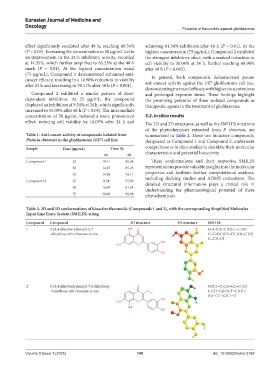
                                                               of the phytochemicals extracted from  P. chinensis, are
            Table 1. Anti‑cancer activity of compounds isolated from   summarized in Table 2. These two bioactive compounds,
            Pistacia chinensis in the glioblastoma (U87) cell line  designated as Compound 1 and Compound 2, underwent

            Sample          Dose (µg/mL)        Time (h)       comprehensive in silico studies to elucidate their molecular
                                             24        48      characteristics and potential bioactivity.
            Compound 1          25           10.11    60.34      These conformations and their respective SMILES
                                50           14.35    65.23    representations provide valuable insights into the molecular
                                75           14.98    70.11    properties and facilitate further computational analyses,
            Compound 2          25           9.54     55.09    including docking studies and ADME evaluations. The
                                                               detailed structural information plays a critical role in
                                50           16.09    61.54    understanding the pharmacological potential of these
                                75           30.06    68.98    phytochemicals.


            Table 2. 2D and 3D conformations of bioactive flavonoids (Compounds 1 and 2), with the corresponding Simplified Molecular
            Input Line Entry System (SMILES) string
            Compound  Compound                          2D structure         3D structure  SMILES
            1         2-(3,4-dihydroxyphenyl)-5,7                                        O=C1C2=C (O) C=C (O)
                      -dihydroxy-4H-chromen-4-one                                        C=C2OC (C3=CC (O)=C (O)
                                                                                         C=C3)=C1


            2         2-(3,4-dihydroxyphenyl)-7,8-dihydroxy                              COC1=C (C2=CC=C (O)
                      -3-methoxy-4H-chromen-4-one                                        C (O)=C2) OC3=C (O) C
                                                                                         (O)=CC=C3C1=O


            Volume 9 Issue 1 (2025)                        149                              doi: 10.36922/ejmo.5768

