


Page 161 - EJMO-9-1
P. 161
Eurasian Journal of Medicine and
            Oncology
                                                                               Potential of flavonoids against glioblastoma


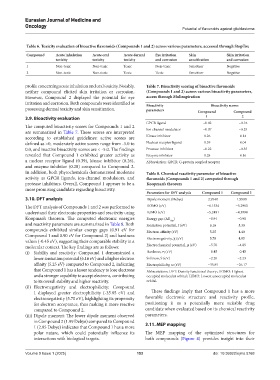
            Table 6. Toxicity evaluation of bioactive flavonoids (Compounds 1 and 2) across various parameters, accessed through StopTox
            Compound     Acute inhalation   Acute oral   Acute dermal   Eye irritation   Skin    Skin irritation
                         toxicity       toxicity      toxicity     and corrosion  sensitization  and corrosion
            1            Non-toxic      Non-toxic     Toxic        Non-toxic     Sensitizer      Negative
            2            Non-toxic      Non-toxic     Toxic        Toxic         Sensitizer      Negative

            profile concerning acute inhalation and oral toxicity. Notably,   Table 7. Bioactivity scoring of bioactive flavonoids
            neither compound elicited skin irritation or corrosion.   (Compounds 1 and 2) across various bioactivity parameters,
            However, Compound 2 displayed the potential for eye   access through Molinspiration
            irritation and corrosion. Both compounds were identified as   Bioactivity      Bioactivity scores
            possessing dermal toxicity and skin sensitization.  parameters           Compound       Compound

            3.9. Bioactivity evaluation                                                  1              2
                                                               GPCR ligand             −0.02           −0.16
            The computed bioactivity scores for Compounds 1 and 2
            are summarized in Table 7. These scores are interpreted   Ion channel modulator   −0.07    −0.25
            according  to established  guidelines:  active  scores  are   Kinase inhibitor   0.26      0.14
            defined as >0, moderately active scores range from -5.0 to   Nuclear receptor ligand  0.39  0.04
            0.0, and inactive bioactivity scores are < -5.0. The findings   Protease inhibitor   −0.22  −0.35
            revealed that Compound 1 exhibited greater activity as   Enzyme inhibitor   0.28           0.16
            a nuclear receptor ligand (0.39), kinase inhibitor (0.26),   Abbreviation: GPCR: G-protein coupled receptor
            and enzyme inhibitor (0.28) compared to Compound 2.
            In addition, both phytochemicals demonstrated moderate   Table 8. Chemical reactivity parameter of bioactive
            activity as GPCR ligands, ion-channel modulators, and   flavonoids (Compounds 1 and 2) computed through
            protease inhibitors. Overall, Compound 1 appears to be a   Koopman’s theorem
            more promising candidate regarding bioactivity.
                                                               Parameters for DFT analysis  Compound 1  Compound 2
            3.10. DFT analysis                                 Dipole moment (Debye)      2.9540      1.9900
            The DFT analysis of Compounds 1 and 2 was performed to   HOMO (eV)           −6.1534     −5.2983
            understand their electronic properties and reactivity using   LUMO (eV)      −5.2491     −4.3998
            Koopman’s  theorem.  The  computed  electronic  energies   Energy gap (ΔE )   −0.91       −0.90
                                                                         Gap
            and reactivity parameters are summarized in Table 8. Both   Ionization potential, I (eV)  6.16  5.30
            compounds exhibited similar energy gaps (0.91 eV for   Electron affinity (eV)  5.25       4.40
            Compound 1 and 0.90 eV for Compound 2) and hardness   Electronegativity, χ (eV)  5.70     4.85
            values (-0.45 eV), suggesting their comparable stability in a
            molecular context. The key findings are as follows:  Electrochemical potential, µ (eV)  −5.70  −4.85
            (i)  Stability and reactivity:  Compound 1 demonstrated a   Hardness, η (eV)  −0.45       −0.45
               lower ionization potential (6.16 eV) and a higher electron   Softness, S (eV)  −2.20   −2.23
               affinity (5.25 eV) compared to Compound 2, indicating   Electrophilicity, ω (eV)  −35.85  −26.17
               that Compound 1 has a lesser tendency to lose electrons   Abbreviations: DFT: Density functional theory; HOMO: Highest
               and a stronger capability to accept electrons, contributing   occupied molecular orbital; LUMO: Lowest unoccupied molecular
               to its overall stability and higher reactivity.  orbital.
            (ii)  Electronegativity and electrophilicity:  Compound
               1 displayed greater electrophilicity (-35.85 eV) and   These findings imply that Compound 1 has a more
               electronegativity (5.70 eV), highlighting its propensity   favorable electronic structure and reactivity profile,
               for electron acceptance, thus making it more reactive   positioning it as a potentially more suitable drug
               compared to Compound 2.                         candidate when evaluated based on its chemical reactivity
            (iii) Dipole moment: The lower dipole moment observed   parameters.
               in Compound 2 (1.99 Debye) compared to Compound
               1 (2.95 Debye) indicates that Compound 1 has a more   3.11. MEP mapping
               polar nature, which could potentially influence its   The MEP mapping of the optimized structures for
               interactions with biological targets.           both compounds (Figure  4) provides insight into their


            Volume 9 Issue 1 (2025)                        153                              doi: 10.36922/ejmo.5768

