


Page 160 - EJMO-9-1
P. 160
Eurasian Journal of Medicine and
            Oncology
                                                                               Potential of flavonoids against glioblastoma


            3.5. Lipophilicity and water solubility            3.8. Toxicity assessment

            The lipophilicity and water solubility of the phytochemicals   The toxicity assessment for the phytochemicals was
            are represented by their log P  values. Compound 1   conducted using the PkCSM server, as summarized
                                      o/w
            exhibited superior lipophilicity with a consensus log P  of   in  Table  5. The results indicated that Compound 1
                                                      o/w
            1.73 compared to Compound 2’s value of 1.52. In contrast,   demonstrated non-toxic  characteristics  across several
            Compound 2 demonstrated enhanced water solubility,   toxicity models, including Ames toxicity, hepatotoxicity,
            as indicated by its log S value of 3.94, in comparison to   hERG I and II inhibitors, and skin sensitization, where
            Compound 1’s log S of 3.82 (Table 4).              it remained inactive. In contrast, Compound 2 displayed
                                                               potential Ames toxicity, suggesting possible carcinogenic
            3.6. Drug-likeness assessment                      effects.
            The drug-likeness of both phytochemicals (Compounds
            1 and 2) was evaluated according to Lipinski, Ghose,   3.8.1. Maximum tolerated dose and toxicity levels
            Veber, and Egan rules. As outlined in  Table  4, neither   The maximum tolerated doses were calculated to be 0.839
            phytochemical violated any of the specified rules. The   log mg/kg/day for Compound 1 and 1.023 log mg/kg/day
            medicinal  chemistry  evaluation  revealed  one  PAINS   for Compound 2. This suggests that Compound 2 is more
            (Pan-Assay Interference Compound) and one Brenk alert   tolerant at higher doses. In addition, Compound 2 exhibited
            for  both  phytochemicals.  Furthermore,  the  synthetic   lower toxicity to both Minnow and Tetrahymena pyriformis,
            accessibility analysis indicated that Compound 1, with a   indicating a more favorable toxicity profile in aquatic
            score of 3.02, is easier  to synthesize  than Compound  2,   environments. However, the oral rat acute and chronic
            which has a score of 3.28.                         toxicity assessments revealed that both phytochemicals
                                                               exhibited similar levels of chronic toxicity, with Compound
            3.7. Pharmacokinetic evaluation                    1 having a slightly lower acute toxicity (2.235  mol/kg)
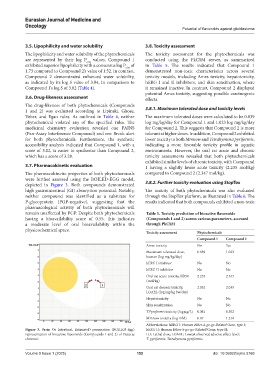
            The pharmacokinetic properties of both phytochemicals   compared to Compound 2 (2.347 mol/kg).
            were further assessed using the BOILED-EGG model,
            depicted in  Figure  3. Both compounds demonstrated   3.8.2. Further toxicity evaluation using StopTox
            high gastrointestinal (GI) absorption potential. Notably,   The toxicity of both phytochemicals was also evaluated
            neither compound was identified as a substrate for   through the StopTox platform, as illustrated in Table 6. The
            P-glycoprotein (PGP-negative), suggesting that the   results indicated that both compounds exhibited a non-toxic
            pharmacological activity of both phytochemicals will
            remain unaffected by PGP. Despite both phytochemicals   Table 5. Toxicity prediction of bioactive flavonoids
            having a bioavailability score of 0.55, this indicates   (Compounds 1 and 2) across various parameters, accessed
            a moderate level of oral bioavailability within the   through PkCSM
            physicochemical space.
                                                               Toxicity assessment   Phytochemicals
                                                                                     Compound 1  Compound 2
                                                               Ames toxicity         No          Yes
                                                               Maximum tolerated dose,   0.839   1.023
                                                               human (log mg/kg/day)
                                                               hERG I inhibitor      No          No
                                                               hERG II inhibitor     No          No
                                                               Oral rat acute toxicity, LD50   2.235  2.347
                                                               (mol/kg)
                                                               Oral rat chronic toxicity,   2.052  2.035
                                                               LOAEL (log mg/kg bw/day)
                                                               Hepatotoxicity        No          No
                                                               Skin sensitization    No          No
                                                               T.Pyriformis toxicity (log µg/L)  0.361  0.302
                                                               Minnow toxicity (log mM)  0.87    1.214
                                                               Abbreviations: hERG I: Human Ether‑à‑go‑go‑Related Gene, type I;
            Figure  3.  Brain  Or  IntestinaL  EstimateD  permeation  (BOILED-Egg)   hERG II: Human Ether-à-go-go-Related Gene, type II;
            representation of bioactive flavonoids (Compounds 1 and 2) of Pistacia   LD: Lethal dose; LOAEL: Lowest observed adverse effect level;
            chinensis                                          T. pyriformis: Tetrahymena pyriformis.


            Volume 9 Issue 1 (2025)                        152                              doi: 10.36922/ejmo.5768

