


Page 180 - EJMO-9-2
P. 180
Eurasian Journal of
            Medicine and Oncology                                       PD-1/L1 inhibitors in advanced CC: Multicenter retro


            and no substantial disparities in clinical characteristics   In a univariate analysis using the Cox regression model,
            were observed. Confounding factors were accounted for in   the use of PD-1/PD-L1 inhibitors in first-line therapy was
            the subsequent analysis.                           associated with better PFS (hazard ratio = 0.43, 95% CI
                                                               0.30 – 0.61, Table 2). While the other factors, including
            3.2. The effects of PD-1/PD-L1 inhibitors on PFS   histology (p=0.73), patient age (p=0.74), surgery (p=0.08),
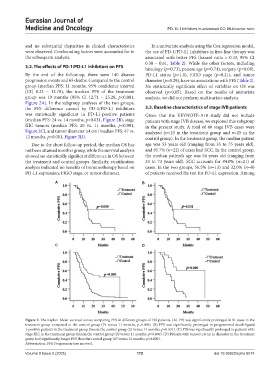
            By the  end of the  follow-up,  there were  140 disease   PD-L1 status (p=1.0), FIGO stage (p=0.21), and tumor
            progression events and 65 deaths. Compared to the control   diameter (p=0.29), have no associations with PFS (Table 2).
            group (median PFS: 11 months, 95% confidence interval   No  statistically significant  effect  of  variables  on  OS was
            [CI] 8.22 – 13.78), the median PFS of the treatment   observed (p>0.05). Based on the results of univariate
            group was 19  months (95% CI 12.71 – 25.29,  p<0.001,   analysis, we did not perform multivariate analysis.
            Figure 2A). In the subgroup analyses of the two groups,
            the PFS difference caused by PD-1/PD-L1 inhibitors   3.3. Baseline characteristics of stage IVB patients
            was  statistically  significant  in  PD-L1-positive  patients   Given that the KEYNOTE-A18 study did not include
            (median PFS: 24 vs. 14 months, p=0.031, Figure 2B), stage   patients with stage IVB disease, we explored this subgroup
            IIIC  tumors  (median  PFS:  20  vs.  11  months,  p<0.001,   in the present study. A total of 48 stage IVB cases were
            Figure 2C), and tumor diameter ≤4 cm (median PFS: 47 vs.   analyzed (n=23 in the treatment group and n=25 in the
            12 months, p<0.001, Figure 2D).                    control group). In the treatment group, the median patient
              Due to the short follow-up period, the median OS has   age was 53 years old (ranging from 35 to 75 years old),
            not been attained in either group, while the survival analysis   and 95.7% (n=22) of cases had SCC. In the control group,
            showed no statistically significant difference in OS between   the median patient’s age was 54 years old (ranging from
            the treatment and control groups. Similarly, stratification   33  to  73  years  old).  SCC  accounts  for  84.0%  (n=21)  of
            analysis indicated no benefits of immunotherapy based on   cases. In the two groups, 56.5% (n=13) and 32.0% (n=8)
            PD-L1 expression, FIGO stage, or tumor diameter.   of patients received the test for PD-L1 expression. Among

                         A                                   B


                        C                                    D


            Figure 2. The Kaplan–Meier survival curves comparing PFS in different groups of 192 patients. (A) PFS was significantly prolonged in 91 cases in the
            treatment group compared to the control group (19 versus 11 months, p=0.000). (B) PFS was significantly prolonged in programmed death-ligand
            1-positive patients in the treatment group than in the control group (24 versus 14 months, p=0.031). (C) PFS was significantly prolonged in patients with
            stage IIIC in the treatment group than in the control group (20 versus 11 months, p=0.000). (D) Patients with tumors ≤4 cm in diameter in the treatment
            group had significantly longer PFS than the control group (47 versus 12 months, p=0.000).
            Abbreviation: PFS: Progression-free survival.
            Volume 9 Issue 2 (2025)                        172                              doi:10.36922/ejmo.8074

