


Page 262 - EJMO-9-2
P. 262
Eurasian Journal of
            Medicine and Oncology                                          The genetics of chronic stress in cervical lesions


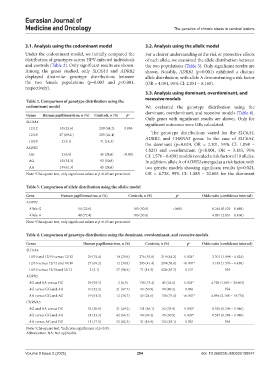
            3.1. Analysis using the codominant model           3.2. Analysis using the allelic model

            Under the codominant model, we initially compared the   For a clearer understanding of the risk or protective effects
            distribution of genotypes across HPV-infected individuals   of each allele, we examined the allele distribution between
            and controls (Table 2). Only significant results are shown.   the two populations (Table 3). Only significant results are
            Among the genes studied, only  SLC6A4 and  ADRB2   shown.  Notably,  ADRB2  (p<0.001)  exhibited a  distinct
            displayed  dissimilar genotype distributions between   allele distribution, with allele A demonstrating a risk factor
            the two female populations (p=0.003 and  p<0.001,   (OR = 4.091, 95% CI: 2.051 – 8.160).
            respectively).
                                                               3.3. Analysis using dominant, overdominant, and
                                                               recessive models
            Table 2. Comparison of genotype distribution using the
            codominant model                                   We evaluated the genotype distribution using the
                                                               dominant, overdominant, and recessive models (Table 4).
            Genes  Human papillomavirus, n (%)  Controls, n (%)   p a
                                                               Only genes with significant results are shown. Only for
            SLC6A4                                             significant outcomes were ORs calculated.
             12/12         10 (25.6)       219 (44.2)  0.003
             12/10        27 (69.2.)       205 (41.4)            The genotype distributions varied for the  SLC6A4,
             10/10         2 (5.1)          71 (14.3)          ADRB2, and  CHRNA5 genes. In the case of  SLC6A4,
                                                               the dominant (p=0.024, OR = 2.301, 95% CI: 1.098 –
            ADRB2                                              4.824) and overdominant (p<0.001, OR = 3.183, 95%
             GG            2 (6.5)          45 (24.6)  <0.001  CI: 1.576 – 6.430) models revealed a risk factor of 10 alleles.
             AG            10 (32.3)        93 (50.8)          In addition, allele A of ADRB2 emerged as a risk factor, with
             AA            19 (61.3)        45 (24.6)          two genetic models showing significant results (p=0.024,
            Note:  Chi-square test, only significant values at p<0.05 are presented.  OR = 4.728, 95% CI: 1.085 – 20.603 for the dominant
                a
            Table 3. Comparison of allele distribution using the allelic model
            Gene           Human papillomavirus, n (%)  Controls, n (%)     p a        Odds ratio (confidence interval)
            ADRB2
             Allele G             14 (22.6)               183 (50.0)      <0.001           0.244 (0.123 – 0.488)
             Allele A             48 (77.4)               183 (50.0)                       4.091 (2.051 – 8.160)
            Note:  Chi-square test, only significant values at p<0.05 are presented.
                a

            Table 4. Comparison of genotype distribution using the dominant, overdominant, and recessive models
            Genes                    Human papillomavirus, n (%)  Controls, n (%)   p a  Odds ratio (confidence interval)
            SLC6A4
             10/10 and 12/10 versus 12/12  29 (74.4)  10 (25.6)  276 (55.8)  219 (44.2)  0.024*  2.301 (1.098 – 4.824)
             12/10 versus 12/12 and 10/10  27 (69.2)  12 (30.8)  205 (41.4)  290 (58.6)  <0.001*  3.183 (1.576 – 6.430)
             10/10 versus 12/10and 12/12  2 (5.1)  37 (94.9)  71 (14.3)  424 (85.7)  0.107       NA
            ADRB2
             AG and AA versus GG      29 (93.5)    2 (6.5)  138 (75.4)  45 (24.6)  0.024*  4.728 (1.085 – 20.603)
             AG versus GG and AA      10 (32.3)   21 (67.7)  93 (50.8)  90 (49.2)  0.056         NA
             AA versus GG and AG      19 (61.3)   12 (38.7)  45 (24.6)  138 (75.4)  <0.001*  4.856 (2.188 – 10.776)
            CHRNA5
             AG and AA versus GG      32 (50.8)   31 (49.2)  121 (66.1)  62 (33.9)  0.030*  0.529 (0.296 – 0.946)
             AG versus GG and AA      21 (33.3)   42 (66.7)  90 (49.2)  93 (50.8)  0.029*  0.517 (0.284 – 0.940)
             AA versus AG and GG      11 (17.5)   52 (82.5)  31 (16.9)  152 (83.1)  0.925        NA
            Note:  Chi-square test, *indicates significance at p<0.05.
                a
            Abbreviation: NA: Not applicable.


            Volume 9 Issue 2 (2025)                        254                         doi: 10.36922/EJMO025100047

