


Page 260 - EJMO-9-2
P. 260
Eurasian Journal of
            Medicine and Oncology                                          The genetics of chronic stress in cervical lesions


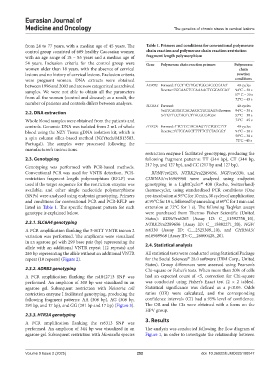
            from 24 to 77 years, with a median age of 45 years. The   Table 1. Primers and conditions for conventional polymerase
            control group consisted of 609 healthy Caucasian women   chain reaction and polymerase chain reaction‑restriction
            with an age range of 18 – 85 years and a median age of   fragment length polymorphism
            54  years. Inclusion criteria for the control group were   Gene  Polymerase chain reaction primers  Polymerase
            women older than 18 years, with the absence of cervical                                    chain
            lesions and no history of cervical lesions. Exclusion criteria                            reaction
            were pregnant women. DNA extracts were obtained                                          conditions
            between 1996 and 2003 and are now categorized as archived   ADRB2 Forward: 5’CCTTCTTGCTGGCACCCCAA3’  40 cycles
            samples. We were not able to obtain all the parameters   Reverse: 5’GGAAGTCCAAAACTCGCACCA3’  94°C – 30 s
            from all the women (control and disease); as a result, the                               57° C – 30 s
                                                                                                     72°C – 45 s
            number of patients and controls differs between analyses.  SLC6A4 Forward:                40 cycles
            2.2. DNA extraction                                      5×GTCAGTATCACAGGCTGCGAG3×Reverse:  94°C – 30 s
                                                                     5×TGTTCCTAGTCTTACGCCAG3×
                                                                                                     57°C – 30 s
            Whole blood samples were obtained from the patients and                                  72°C – 45 s
            controls. Genomic DNA was isolated from 2 mL of whole   HTR2A Forward: 5’TCTGCTACAAGTTCTGGCTT3’  40 cycles
            blood using the NZY Tissue gDNA isolation kit, which is   Reverse: 5’CTGCAGCTTTTTCTCTAGGG3’  94°C – 30 s
            a spin column silica-based method (NZYtech/MB13503,                                      50°C – 30 s
                                                                                                     72°C –45 s
            Portugal). The  samples  were processed  following  the
            manufacturer’s instructions.
                                                               restriction enzyme I facilitated genotyping, producing the
            2.3. Genotyping                                    following  fragment  patterns:  TT  (344  bp),  CT  (344  bp,

            Genotyping was performed with PCR-based methods.   217 bp, and 127 bp), and CC (217 bp and 127 bp).
            Conventional PCR was used for VNTR detection, PCR-   BDNF/rs6265,  NTRK2/rs2289656,  NGF/rs6330, and
            restriction fragment length polymorphism (RFLP) was   CHRNA5/rs16969968 were analyzed using endpoint
            used if the target sequence for the restriction enzyme was   genotyping in a LightCycler  408 (Roche, Switzerland)
                                                                                      ®
            available, and other single nucleotide polymorphisms   thermocycler, using standardized PCR conditions (One
            (SNPs) were analyzed using endpoint genotyping. Primers   pre-incubation at 95°C for 10 min, 30 cycles of amplification
            and conditions for conventional PCR and PCR-RFLP are   at 95°C for 10 s, followed by annealing at 60°C for 1 min and
            listed  in  Table  1.  The  specific  fragment  pattern  for  each   extension at 72°C for 1 s). The following TaqMan assays
            genotype is explained below.                       were purchased from Thermo Fisher Scientific (United
                                                               States):  BDNF/rs6265 (Assay ID: C__11592758_10),
            2.3.1. SLC6A4 genotyping                           NTRK2/rs2289656 (Assay ID: C__15882271_20),  NGF/
            A PCR amplification flanking the 5-HTT VNTR intron 2   rs6330 (Assay ID: C__2525309_10), and  CHRNA5/
            variation was performed. The amplicons were visualized   rs16969968 (Assay ID: C__26000428_20).
            in an agarose gel with 299 base pair (bp) representing the
            allele with an additional VNTR repeat (12 repeats) and   2.4. Statistical analysis
            265 bp representing the allele without an additional VNTR   All statistical tests were conducted using Statistical Package
            repeat (10 repeats) (Figure 2).                    for the Social Sciences  28.0 software (IBM Corp., United
                                                                                 ®
                                                               States).  Group differences  were assessed  using Pearson’s
            2.3.2. ADRB2 genotyping                            Chi-square or Fisher’s tests. When more than 20% of cells
            A PCR amplification flanking the rs1042713 SNP was   had an expected count of <5, correction for Chi-square
            performed. An amplicon of 308 bp was visualized in an   was conducted using Fisher’s Exact test (2 × 2  tables).
            agarose  gel. Subsequent  restriction with  Neisseria coli   Statistical  significance  was  defined  as  a  p<0.05.  Odds
            restriction enzyme I facilitated genotyping, producing the   ratios (OR) were calculated, and the corresponding
            following fragment patterns: AA (308  bp), AG (308  bp,   confidence intervals (CI) had a 95% level of confidence.
            291 bp, and 17 bp), and GG (291 bp and 17 bp) (Figure 3).  The OR and the CIs were obtained with a focus on the
                                                               HPV group.
            2.3.3. HTR2A genotyping
                                                               3. Results
            A PCR amplification flanking the rs6313 SNP was
            performed. An amplicon of 344 bp was visualized in an   The analysis was conducted following the flow diagram of
            agarose gel. Subsequent restriction with Moraxella species   Figure 1, in order to investigate the relationship between


            Volume 9 Issue 2 (2025)                        252                         doi: 10.36922/EJMO025100047

