


Page 169 - EJMO-9-3
P. 169
Eurasian Journal of
            Medicine and Oncology                                                 Psychological care for cancer patients


            Table 4. Predicting psychotherapists’ perceptions of psychological service quality for cancer patients
            Domains               Model      ANOVA                             Regression
                                 summary
                                 R    R 2  F   DF   Sig.  Independent variable  B  Standard error  β  t  p‑value
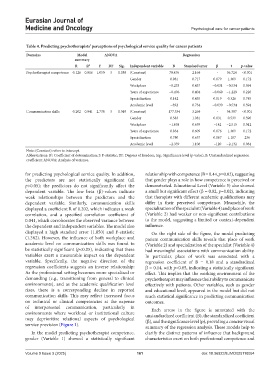
            Psychotherapist competence  0.126  0.016  1.050  5  0.388  (Constant)  79.476  2.164  -  36.724  <0.001
                                                        Gender           0.981     0.717    0.079  1.369  0.172
                                                        Workplace        −0.233    0.437   −0.031  −0.534  0.594
                                                        Years of experience  −0.496  0.404  −0.069  −1.229  0.220
                                                        Specialization   0.142     0.435    0.019  0.326  0.745
                                                        Academic level    −392     0.734   −0.030  −0.534  0.594
            Communication skills  0.202  0.041  2.738  5  0.019  (Constant)  177.534  3.264  -    54.397  <0.001
                                                        Gender           0.583     1.081    0.031  0.539  0.590
                                                        Workplace        −1.658    0.659    −142  −2.515  0.012
                                                        Years of experience  0.834  0.609   0.076  1.369  0.172
                                                        Specialization   0.780     0.657    0.067  1.187  236
                                                        Academic level   −2.359    1.106    −120  −2.132  0.034
            Note: (Constant) refers to intercept.
            Abbreviations: R : Coefficient of determination; F: F-statistic; DF: Degrees of freedom; Sig.: Significance level (p-value), B: Unstandardized regression
                       2
            coefficient; ANOVA: Analysis of variance.
            for predicting psychological service quality. In addition,   relationship with competence (B = 0.44, p=0.02), suggesting
            the predictors are not statistically significant (all   that gender plays a role in how competence is perceived or
            p>0.05); the predictors do not significantly affect the   demonstrated. Educational Level (Variable 5) also showed
            dependent variable. The low beta (β)-values indicate   a small but significant effect (β = 0.02, p=0.02), indicating
            weak  relationships between  the predictors and the   that therapists with different academic qualifications may
            dependent variable. Similarly, communication skills   differ in their perceived competence. Meanwhile, the
            displayed a coefficient R of 0.202, which indicates a weak   specialization of the specialist (Variable 4) and place of work
            correlation, and a specified correlation coefficient of   (Variable 2) had weaker or non-significant contributions
            0.041, which corroborates the observed variance between   to the model, suggesting a limited or context-dependent
            the dependent and independent variables. The model also   influence.
            displayed a high standard error (1.050) and F-statistic   On the right side of the figure, the model predicting
            (1.382).  However,  the  influence  of  both  workplace  and   patient communication skills reveals that place of work
            academic level on communication skills was found to   (Variable 2) and specialization of the specialist (Variable 4)
            be statistically significant (p<0.05), indicating that these   had meaningful associations with communication ability.
            variables exert a measurable impact on the dependent   In particular, place of work was associated with a
            variable. Specifically, the negative direction of the   regression coefficient  of  B  =  0.18 and  a  standardized
            regression coefficients suggests an inverse relationship:   β = 0.14, with p<0.05, indicating a statistically significant
            As the professional setting becomes more specialized or   effect. This implies that the working environment of the
            demanding (e.g.,  transitioning from  general to clinical   psychotherapist may influence their ability to communicate
            environments), and as the academic qualification level   effectively with patients. Other variables, such as gender
            rises, there is a corresponding decline in reported   and educational level, appeared in the model but did not
            communication  skills. This  may  reflect increased focus   reach statistical significance in predicting communication
            on technical or clinical competencies at the expense   outcomes.
            of interpersonal communication, particularly in      Each arrow in the figure is annotated with the
            environments where workload or institutional culture   unstandardized coefficient (B), the standardized coefficient
            may  deprioritize  relational  aspects  of  psychological   (β), and the significance level (p), providing a concise visual
            service provision (Figure 1).
                                                               summary of the regression analysis. These models help to
              In the model predicting psychotherapist competence,   clarify the distinct patterns of influence that background
            gender (Variable 1) showed a statistically significant   characteristics exert on both professional competence and


            Volume 9 Issue 3 (2025)                        161                         doi: 10.36922/EJMO025110054

