


Page 168 - EJMO-9-3
P. 168
Eurasian Journal of
            Medicine and Oncology                                                 Psychological care for cancer patients


            Table 1. Characteristics of study participants     Table 2. Participants’ communication skills scale scores
                                                               across different dimensions
            Characteristic             Frequency  Percentage
            Gender                                             Dimension                             Score
             Male                        161         48.9      Media communication                47.5745±6.96078
             Female                      168         51.1      Empathy                            54.1976±5.41907
            Workplace                                          Respect and authenticity           19.2827±1.75540
             Psychiatric clinic          131         39.8      Social skills                      53.8207±3.46429
             Hospital                    106         32.2      Total                             174.8754±9.53202
             School and rehabilitation centers  92   28.0      Note: Scores are presented as mean±standard deviation.
            Specialization
                                                               Table 3. Participants’ self‑efficacy scale scores across
             Clinical psychology         178         54.1
                                                               different dimensions
             Psychological counseling     75         22.8
             Mental health                76         23.1      Dimension                             Score
            Experience                                         Relational competence              14.0304±3.13015
             <5 years                    164         49.8      Communicative effectiveness        16.2340±3.49345
             5 – 10 years                 69         21.0      Psychological competence           12.5046±1.97565
             More than 10 years           96         29.2      Clinical competence                20.4073±2.27488
            Academic degree                                    Influence regulation               7.9514±0.94872
             Bachelor                    207         62.9      Diagnostic skills                  8.2036±2.28286
             Postgraduate                122         37.1      Total                              79.3313±6.24082
                                                               Note: Scores are presented as mean±standard deviation.

            participants varied as follows: 131  (39.8%) participants   clinical skills; the standard deviation implies limited
            worked in psychiatric clinics, 106  (32.2%) in hospitals,   variations in participant response. The second highest
            and 92 (28.0%) in schools and rehabilitation centers. The   mean score was obtained for communicative effectiveness
            distribution of participants according to their specializations   (16.2340 ± 3.49345), thus reflecting the importance
            is as follows: 178 (54.1%) participants specialized in clinical   of effective communication for treatment success; the
            psychology, 75 (22.8%) in psychological counseling, and   standard  deviation  implies  a  relative  variation  in  this
            76 (23.1%) in mental health. Among them, 164 (49.8%)   domain between psychotherapists. The lowest mean score
            participants had <5 years of experience, 69 (21.0%) had   was  reported  for  diagnostic  skills  (8.2036  ±  2.28286),
            5 – 10  years of experience, and 96  (29.2%) had more   prompting further improvements compared to the other
            than 10 years of experience. In addition, 207 participants   dimensions. The overall score of the self-efficacy scale was
            received a bachelor’s degree (62.9%), whereas 122 (37.1%)   79.3313 ± 6.24092, reflecting a good level of efficacy with
            participants had a postgraduate degree.            some variation among the participants.
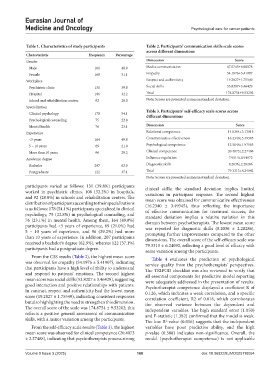
              From the CSS results (Table 2), the highest mean score    Table  4  evaluates the prediction of psychological
            was observed for empathy (54.1976 ± 5.41907), indicating   service quality from the psychotherapists’ perspectives.
            that participants have a high level of ability to understand   The TRIPOD checklist was also reviewed to verify that
            and respond to patients’ emotions. The second highest   all essential components for predictive model reporting
            mean score was social skills (53.8207 ± 3.46429), suggesting   were adequately addressed in the presentation of results.
            good interaction and positive relationships with patients.   Psychotherapist competence displayed a coefficient R of
            In contrast, respect and authenticity had the lowest mean   0.126, which indicates a weak correlation, and a specific
            score (19.2827 ± 1.75540), indicating consistent responses   correlation coefficient, R2 of 0.016, which corroborates
            but also highlighting the need to strengthen this dimension.   the observed variance between the dependent and
            The overall score of the scale was 174.8754 ± 9.53202; this   independent variables. The high standard error (1.050)
            reflects a positive general assessment of communication   and F-statistic (1.382) confirmed that the model is weak.
            skills, with a minor variation among the participants.  The low R -value (0.016) suggests that the independent
                                                                       2
              From the self-efficacy scale results (Table 3), the highest   variables have poor predictive ability, and the high
            mean score was observed for clinical competence (20.4073   p-value  (0.388) indicates non-significance. Overall, the
            ± 2.27488), indicating that psychotherapists possess strong   model (psychotherapist competence) is not applicable


            Volume 9 Issue 3 (2025)                        160                         doi: 10.36922/EJMO025110054

