


Page 212 - EJMO-9-3
P. 212
Eurasian Journal of
            Medicine and Oncology                                              FN3K–Nrf2 axis inhibition in breast cancer


            accommodates unequal variances and is appropriate   homologous templates, highlighting the conserved regions
            for datasets  with small sample  sizes.   To mitigate the   and secondary structural elements.
                                           51
            risk of false positives due to multiple comparisons, the   Quality assessment of these 50 templates was performed
            Benjamini-Hochberg procedure was applied to control the   using QMEAN and GMQE scores. QMEAN evaluates the
            False Discovery Rate (FDR). 52                     overall geometric and energetic quality of the model, while
            2.3.3. Significance thresholds used                GMQE estimates the expected accuracy of the homology
                                                               model. Templates were ranked based on these criteria,
            The following significance thresholds were applied in   with the top three templates demonstrating the highest
            the analysis:  p<0.05 (*; marginally significant),  p<0.01   scores and best alignment with the target sequence. In
            (**; significant), p<0.001 (***; highly significant), p≥0.05 →   the subsequent protein modeling, three homology models
            (not significant). All statistical analyses were conducted in   (Figure 2) were developed, and the first model, based on
            Python utilizing the SciPy and statsmodels libraries, with   the template from  Arabidopsis thaliana  FN3K,  exhibited
            statsmodels. stats. multitest applied for FDR correction.  a sequence similarity of 90.61% with human FN3K and
            3. Results and discussion                          was selected for the study. This model was evaluated using
                                                               GMQE and QMEAN scoring functions, where values
            3.1. SBVS                                          approaching 1.0 on a scale from 0 to 1 indicate high model
                                                               quality. The modeled protein structure (Model-1) achieved
            3.1.1. Template selection and model validation     satisfactory scores, meeting the quality attributes necessary
            Template selection for homology modeling of the human   for a reliable model.
            FN3K enzyme was carried out by aligning the target protein   Further validation was carried out using the
            sequence  with  evolutionarily  related  structures  available   PROCHECK tool to assess the stereochemical quality
            in the SWISS-MODEL template library. To identify   of  the model.  PROCHECK  provided  a  Ramachandran
            suitable homologous templates, the FN3K amino acid   plot (Figure  3), which is instrumental in evaluating the
            sequence was queried against the PDB-BLAST database.   overall geometry of the protein model based on residue-
            This search initially yielded 5,643 potential templates that   by-residue analysis of backbone dihedral angles (ϕ and ψ).
            matched the target sequence. To refine this extensive list,   The Ramachandran plot analysis revealed that most of the
            a heuristic approach was employed, narrowing it down   residues were located in the favored regions, indicating
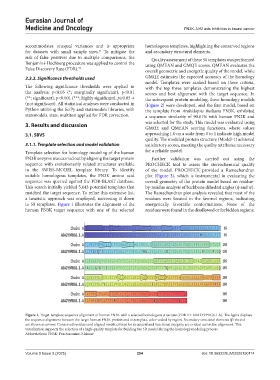
            to 50 templates. Figure 1 illustrates the alignment of the   energetically  favorable  conformations.  None  of  the
            human FN3K target sequence with one of the selected   residues were found in the disallowed or forbidden regions,


            Figure 1. Target-template sequence alignment of human FN3K with a selected homologous structure (PDB ID: A0A2Y9PDG6.1.A). The figure displays
            the sequence alignment between the target human FN3K protein and its template, color-coded by region. Secondary structural elements (β-sheets)
            are shown as arrows. Conserved residues and aligned motifs critical for structural and functional integrity are evident across the alignment. This
            visualization supports the selection of a high-quality template for building the 3D model during the homology modeling process
            Abbreviations: FN3K: Fructosamine-3-kinase


            Volume 9 Issue 3 (2025)                        204                         doi: 10.36922/EJMO025150114

