


Page 251 - EJMO-9-3
P. 251
Eurasian Journal of
            Medicine and Oncology                                            Nursing students’ views on advance directives


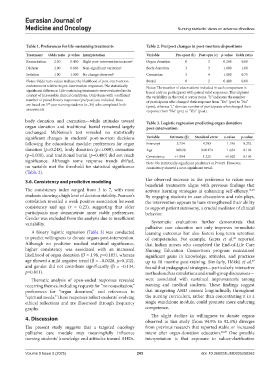
            Table 1. Preferences for life‑sustaining treatments  Table 2. Pre/post changes in post‑mortem dispositions
            Treatment  Odds ratio p‑value Interpretation       Variable     Pre→post (b) Post→pre (c) p‑value Odds ratio
            Resuscitation  2.50  0.450  Slight post-intervention increase a  Organ donation  0  3  0.248  0.00
            Dialysis    2.00   0.683  Non-significant variation a  Body donation  3       3     1.000   1.00
            Sedation    1.00   1.000  No change observed a     Cremation        3         4     1.000   0.75
            Notes: Odds ratio values indicate the likelihood of post-intervention   Burial  0  2  0.480  0.00
            endorsement relative to pre-intervention responses.  No statistically   Notes: The number of observations included in each comparison is
                                             a
            significant difference. Life-sustaining treatments were evaluated in the   based only on participants with paired valid responses. This explains
            context of irreversible clinical conditions. Only items with a sufficient   the variability in the total n across items. “b” indicates the number
            number of paired binary responses (pre/post) are included. Data   of participants who changed their response from “Yes” (pre) to “No”
            are based on 3 -year nursing students (n=39) who completed both   (post), whereas “c” denotes number of participants who changed their
                     rd
            assessments.                                       response from “No” (pre) to “Yes” (post).
            body donation and cremation—while attitudes toward   Table 3. Logistic regression predicting organ donation
            organ donation and traditional burial remained largely   post‑intervention
            unchanged. McNemar’s test revealed no statistically
            significant changes in students’ post-mortem decisions   Variable  Estimate (β)  Standard error  z‑value  p‑value
            following the educational module: preferences for organ   Intercept  –5.734  4.793   –1.196  0.232
            donation (p=0.248), body donation (p=1.000), cremation   Age   –0.0028     0.00174   –1.634  0.102
            (p=1.000), and traditional burial (p=0.480) did not reach   Consistency  +1.984  1.225  +1.620  0.105
            significance. Although some response trends shifted,   Note: No statistically significant predictors at P=0.05. However,
            no variable met the threshold for statistical significance   consistency showed a near-significant trend.
            (Table 2).

            3.6. Consistency and predictive modeling           The observed increase in the preference to refuse non-
                                                               beneficial treatments aligns with previous findings that
            The consistency index ranged from 3 to 7, with most   activate learning strategies in enhancing self-efficacy. 18,25
            students showing a high level of decision stability. Pearson’s   By engaging students in case discussions and role-plays,
            correlation revealed a weak positive association between   the intervention appears to have strengthened their ability
            consistency and age (r = 0.23), suggesting that older   to support patient autonomy, a crucial mediator of clinical
            participants may demonstrate more stable preferences.   behavior.
            Gender was excluded from the analysis due to insufficient
            variability.                                         Systematic evaluations further demonstrate that
                                                               palliative care education not only improves immediate
              A binary logistic regression (Table  3) was conducted   learning outcomes but also fosters long-term retention
            to predict willingness to donate organs post-intervention.   of competencies.  For example, Gupta  et al.  reported
                                                                                                    26
            Although  no  predictor  reached  statistical  significance,   that  Indian  nurses  who  completed  the  End-of-Life  Care
            higher consistency was associated with an increased   Nursing Education Consortium program maintained
            likelihood of organ donation (β = 1.98, p=0.105), whereas   significant gains in knowledge, attitudes, and practices
            age showed a mild negative trend (β = –0.0028, p=0.102),   up to 18  months post-training. Similarly, Hökkä  et al.
                                                                                                            27
            and gender did not contribute significantly (β = –0.134,   found that pedagogical strategies—particularly interactive
            p=0.811).                                          methods such as simulations and small-group discussions—
              Thematic  analysis  of  open-ended  responses  revealed   were associated with sustained improvements among
            recurring themes, including requests for “no resuscitation,”   nursing and medical students. These findings suggest
            preferences for “organ donation,” and references to   that integrating AHD content longitudinally throughout
            “spiritual needs.” These responses reflect students’ evolving   the nursing curriculum, rather than concentrating it in a
            ethical reflections and  are illustrated through frequency   single standalone module, could promote more enduring
            graphs.                                            competence.
                                                                 The slight decline in willingness to donate organs
            4. Discussion                                      observed in this study (from 94.9% to 92.3%) diverges
            The  present  study  suggests  that  a  targeted  oncology   from previous research that reported stable or increased
            palliative care module may meaningfully influence   intent after organ-donation education. 28,29  One possible
            nursing students’ knowledge and attitudes toward AHDs.   interpretation  is  that  exposure  to  values-clarification


            Volume 9 Issue 3 (2025)                        243                         doi: 10.36922/EJMO025250263

