


Page 76 - EJMO-9-3
P. 76
Eurasian Journal of
            Medicine and Oncology                                              Molecular shift in FLT3 during AML course


            Table 1. Summary of included studies
            Study       Year of   Number  Mutation (s)  References
                        publication of   evaluated
                                 patients
            Kottaridis et al.  2002  44  FLT3-ITD;   26
                                        FLT3-TKD
            Nakamura et al.  2004   24  FLT3-ITD;    27
                                        FLT3-TKD
            Tiesmeier et al.  2004  31  FLT3-ITD;    28
                                        FLT3-TKD
            Suzuki et al.  2005     39  FLT3-ITD;    29
                                        FLT3-TKD
            Cloos et al.   2006     38  FLT3-ITD;    30
                                        FLT3-TKD
            Palmisano et al.  2007  28  FLT3-ITD;    31
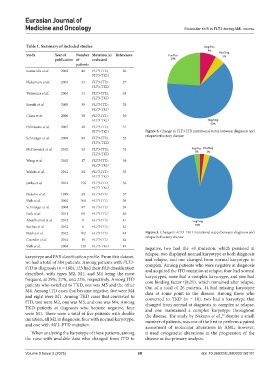
                                        FLT3-TKD               Figure 2. Change in FLT3-ITD mutational status between diagnosis and
                                                               relapse/refractory disease
            Schnittger et al.  2009  80  FLT3-ITD;   32
                                        FLT3-TKD
            McCormick et al.  2010  50  FLT3-ITD;    33
                                        FLT3-TKD
            Wang et al.    2010     17  FLT3-ITD;    34
                                        FLT3-TKD
            Wakita et al.  2012     34  FLT3-ITD;    35
                                        FLT3-TKD
            Janke et al.   2014    156  FLT3-ITD;    36
                                        FLT3-TKD
            Nakano et al.  1999     28  FLT3-ITD     37
            Shih et al.    2002    108  FLT3-ITD     38
            Schnittger et al.  2004  97  FLT3-ITD    39
            Park et al.    2011     69  FLT3-ITD     40
            Abdelhamid et al.  2012  8  FLT3-ITD     41
            Bachas et al.  2012     6   FLT3-ITD     42
            Nazha et al.   2012    102  FLT3-ITD     43        Figure 3. Change in FLT3-TKD mutational status between diagnosis and
                                                               relapse/refractory disease
            Gourdin et al.  2014    15  FLT3-ITD     44
            Shih et al.    2004    120  FLT3-TKD     45        negative, two had the +8 mutation, which persisted at
                                                               relapse, two displayed normal karyotype at both diagnosis
            karyotype and FAB classification profile. From this dataset,   and relapse, and one changed from normal karyotype to
            we had a total of 384 patients. Among patients with FLT3-  complex. Among patients who were negative at diagnosis
            ITD at diagnosis (n = 160), 123 had their FAB classification   and acquired the ITD mutation at relapse, four had normal
            described, with types M2, M1, and M4 being the most   karyotypes, none had a complex karyotype, and one had
            frequent, at 29%, 27%, and 22%, respectively. Among ITD   core binding factor t(8;21), which remained after relapse.
            patients who switched to TKD, one was M5 and the other   Out of a total of 26  patients, 14 had missing karyotype
            M4. Among ITD cases that became negative, five were M4   data at some point in the disease. Among those who
            and eight were M1. Among TKD cases that converted to   converted to TKD (n = 10), two had a karyotype that
            ITD, two were M2, one was M5, and one was M4. Among   changed from normal at diagnosis to complex at relapse,
            TKD patients at diagnosis who became negative, four   and one maintained a complex karyotype throughout
            were M1. There were a total of five patients with double   the disease. The study by Nakano et al.,  despite a small
                                                                                               37
            mutation, all M2 at diagnosis, four with normal karyotype,   number of patients, was one of the first to perform a paired
            and one with MLL-PTD mutation.                     assessment of molecular alterations in AML; however,
              When analyzing the karyotype of these patients, among   it  used cytogenetic  alterations in  the  progression  of the
            the nine with available data who changed from ITD to   disease as the primary analysis.


            Volume 9 Issue 3 (2025)                         68                         doi: 10.36922/EJMO025150101

