


Page 53 - ESAM-1-1
P. 53
Engineering Science in
            Additive Manufacturing                                                Additive manufacturing of EH36 steels


            distribution (PSD) range present good flowability and layer   feedstock properties, processing characteristics, and
            uniformity, as the likelihood of powder agglomeration   typical  applications.  This  comparison  summarizes  the
            is significantly reduced to achieve efficient packing.  Wu   advantages and constraints of each method. PBF-LB offers
                                                      56
            et al.  used EH36 powder with a PSD of 28 – 50 µm, a tapped   superior precision and surface quality, DED-LB provides
               28
            density of 5.1 g/cc, and a Hall flow rate of 27.6 s/50 g. These   greater scalability and process efficiency, while DED-Arc
            specifications were chosen to enhance powder flowability   is recognized for its cost-effectiveness and high material
            and ensure optimal packing density within the powder bed   deposition rates.
            for PBF-LB. This optimized size range enhances powder
            spreading, reduces inter-particle friction, and minimizes   3. Microstructure evolution, defects, and
            defects, such as incomplete melting, during the layer-by-layer   mechanical properties of AMed EH36 steel
            fabrication process.  Unlike PBF-LB, which requires highly   3.1. Melt pool and microstructural characteristics of
                           28
            flowable powders with narrow particle size distributions,   AMed EH36 steel
            DED-LB can utilize powders with lower flowability due to
            its direct feeding mechanism. The EH36 powder designed   The melt pool dimensions and heat-affected zone (HAZ)
            for PBF-LB can be directly used in DED-LB. Meanwhile,   characteristics are fundamental to understanding the
            powders produced by gas atomization with particle sizes   microstructural evolution and mechanical performance
            ranging from 45 to 90 µm and tapped density of 5 g/cc,   of AMed EH36 steel components. Each AM method,
            are also suitable for DED-LB. Such flexibility of powder   including PBF-LB, DED-LB, and DED-Arc, employs
            feedstock offers high deposition efficiency while relaxing   distinct thermal input strategies and cooling rates, resulting
            the constraints associated with feedstock preparation. 28,35    in unique melt pool sizes and HAZ profiles. These variations
            The broader PSD range accepted by DED-LB facilitates   directly influence grain morphology, phase distribution,
            the use of cost-effective powders while still meeting the   and residual stresses in the fabricated material. PBF-LB
            mechanical and structural demands of marine and offshore   process creates small melt pools, typically ranging from 50
            applications.  The chemical composition (wt.%) of EH36   to 100 µm in depth and 100 – 200 µm in width, due to
                      57
                                                                                                       32
            steel powder, typically consisting of C (0.18), Si (0.1 – 0.5),   its localized energy input and rapid cooling rates.  These
            Mn (0.9 – 1.6), P (0.035), S (0.035), Cr (0.2), Mo (0.08), Ni   compact melt pools contain elongated cellular-dendritic
            (0.4), V (0.05 – 0.1), Cu (0.35), Nb (0.02 – 0.05), Ti (0.02),   grains, approximately 1 ± 0.5  µm, with finer acicular
                                                               grains with a size of 1 – 2 µm and equiaxed grains around
            and Fe (balance),  significantly influences its mechanical   5 – 6 µm near the center of the melt pool. The high cooling
                          32
            properties and suitability for AM processes, contributing   rate, ranging from 10⁵ to 10⁶ K/s, ensures that the thermal
            to its high strength, toughness, and weldability critical for   effects are confined to the immediate vicinity of the melt
            marine  and  offshore  applications. Compared to  PBF-LB   pool, resulting in refined microstructures and narrow
            and DED-LB, DED-Arc uses wire feedstock that is easier   HAZs. The rapid solidification of PBF-LB leads to the
            to handle and eliminates the need for stringent powder   micro-segregation of elements such as carbon, manganese,
            flowability requirements. 58                       and other alloying elements at the grain boundaries. This
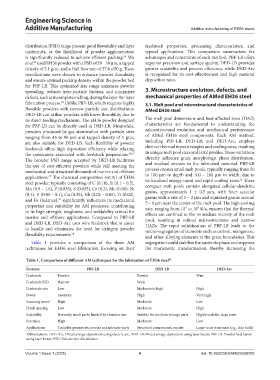
              Table 1 provides a comparison of the three AM    segregation could stabilize the austenite phase and suppress
            techniques for EH36 steel fabrication, focusing on their   the martensitic transformation, thereby increasing the

            Table 1. Comparison of different AM techniques for the fabrication of EH36 steel 59

            Features                  PBF‑LB                       DED‑LB                    DED‑Arc
            Feedstock     Powder                           Powder                   Wire
            Feedstock PSD  Narrow                          Wide                     -
            Feedstock rate  Low                            Moderate to high         High
            Power         moderate                         High                     Very high
            Scanning speed  High                           Moderate                 Low
            Hatch spacing  Low                             Moderate                 High
            Scalability   Normally small parts, limited by chamber size  Suitable for medium to large parts  Highly scalable, large parts
            Precision     High                             Moderate                 Low
            Applications  Complex geometries, precise and intricate parts  Structural components, repairs  Large-scale structures (e.g., ship hulls)
            Abbreviations: DED-Arc: Direct energy deposition using electric arc; DED-LB: Direct energy deposition using laser beam; PBF-LB: Powder bed fusion
            using laser beam; PSD: Particle size distribution.


            Volume 1 Issue 1 (2025)                         4                          doi: 10.36922/ESAM025060005

