


Page 56 - ESAM-1-1
P. 56
Engineering Science in
            Additive Manufacturing                                                Additive manufacturing of EH36 steels


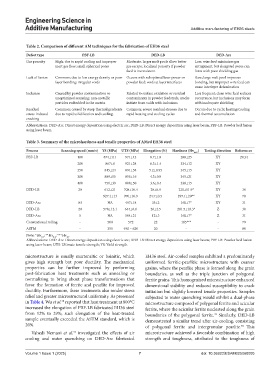
            Table 2. Comparison of different AM techniques for the fabrication of EH36 steel
            Defect type             PBF‑LB                       DED‑LB                      DED‑Arc
            Gas porosity  High; due to rapid cooling and improper   Moderate; larger melt pools allow better   Low; wire feed minimizes gas
                         inert gas flow; small spherical pores  gas escape; localized porosity if powder   entrapment, but elongated pores can
                                                       feed is inconsistent         form with poor shielding gas
            Lack of fusion  Common; due to low energy density or poor  Occurs with suboptimal laser power or   Rare; large melt pool improves
                         layer bonding; irregular voids  powder feed; voids at layer interfaces  bonding, but improper wire feed can
                                                                                    cause interlayer delamination
            Inclusion    Caused by powder contamination or   Related to surface oxidation or residual   Less frequent; clean wire feed reduces
                         unoptimized scanning; non-metallic   contaminants in powder feedstock; cracks   occurrence, but inclusions may form
                         particles embedded in the matrix  initiate from voids with inclusions  with inadequate shielding
            Residual     Common; caused by steep thermal gradients  Common; severe residual stresses due to   Occurs due to cyclic heating/cooling
            stress-induced   due to rapid solidification and cooling;   rapid heating and cooling cycles  and thermal accumulation
            cracking
            Abbreviations: DED-Arc: Direct energy deposition using electric arc; DED-LB: Direct energy deposition using laser beam; PBF-LB: Powder bed fusion
            using laser beam.

            Table 3. Summary of the microhardness and tensile properties of AMed EH36 steel
            Process        Scanning speed (mm/s)  YS (MPa)  UTS (MPa)  Elongation (%)  Hardness (Hv 0.05 )  Testing direction  References
            PBF-LB                100        874±111  971±43     8.7±1.8      288±25         XY        29,34
                                  200         867±8   921±28     6.3±1.4      334±12         XY
                                  250        845±24   891±38    5.2±0.95      345±15         XY
                                  300        809±15   855±16     4.3±0.9      345±21         XY
                                  400        751±39   808±50     3.6±0.4      338±15         XY
            DED-LB                20         612±21   708±10.4   28±0.9      220±11.9*       XY         30
                                             927.1±13  970±10.9  24.7±0.5    297.1±20**      XY         78
            DED-Arc               0.5          NA     497±18      35±2        160±7*         XY         31
            DED-LB                20         578±12.1  644±6.8   26±2.5     281.5±18.3*      Z          30
            DED-Arc                5           NA     504±21      12±3        160±7*         Z          31
            Conventional rolling   -           500     572        22          185***          -         79
            ASTM                   -           355    490 – 620   20            -             -         80
            Note: *Hv ; **Hv ; ***Hv .
                             10
                        0.2
                   0.3
            Abbreviations: DED-Arc: Direct energy deposition using electric arc; DED-LB: Direct energy deposition using laser beam; PBF-LB: Powder bed fusion
            using laser beam; UTS: Ultimate tensile strength; YS: Yield strength.
            microstructure is usually  martensitic  or bainitic, which   EH36 steel. Air-cooled samples exhibited a predominantly
            gives  high  strength  but  poor  ductility.  The  mechanical   uniformed ferritic-pearlitic microstructure with coarser
            properties can be further improved by performing   grains, where the pearlite phase is formed along the grain
            post-fabrication  heat treatments  such as  annealing  or   boundaries, as well as the triple junction of polygonal
            normalizing to bring about phase transformations that   ferrite grains. This homogenized microstructure enhanced
            favor  the  formation  of  ferrite  and pearlite  for  improved   dimensional stability and reduced susceptibility to crack
            ductility. Furthermore, these treatments also render stress   initiation but slightly lowered tensile properties. Samples
            relief and greater microstructural uniformity. As presented   subjected to water quenching would exhibit a dual-phase
            in Table 4, Wu et al.  reported that heat treatment at 800°C   microstructure composed of polygonal ferrite and acicular
                           28
            increased the elongation of PBF-LB fabricated EH36 steel   ferrite, where the acicular ferrite nucleated along the grain
            from 12% to 29%; such elongation of the heat-treated   boundaries of the polygonal ferrite.  Similarly, DED-LB
                                                                                            31
            sample eventually exceeded the ASTM standard, which is   demonstrated a similar trend after air-cooling, consisting
            20%.                                               of  polygonal  ferrite  and  intergranular  pearlite.   This
                                                                                                        78
              Vahedi Nemani  et al.  investigated the effects of air   microstructure achieved a favorable combination of high
                                31
            cooling and water quenching on DED-Arc fabricated   strength and toughness, attributed to the toughness of

            Volume 1 Issue 1 (2025)                         7                          doi: 10.36922/ESAM025060005

